From the glaciers of the Swiss Alps to the palm trees of Tirano — a journey through one of the most scenic rail routes in the world.
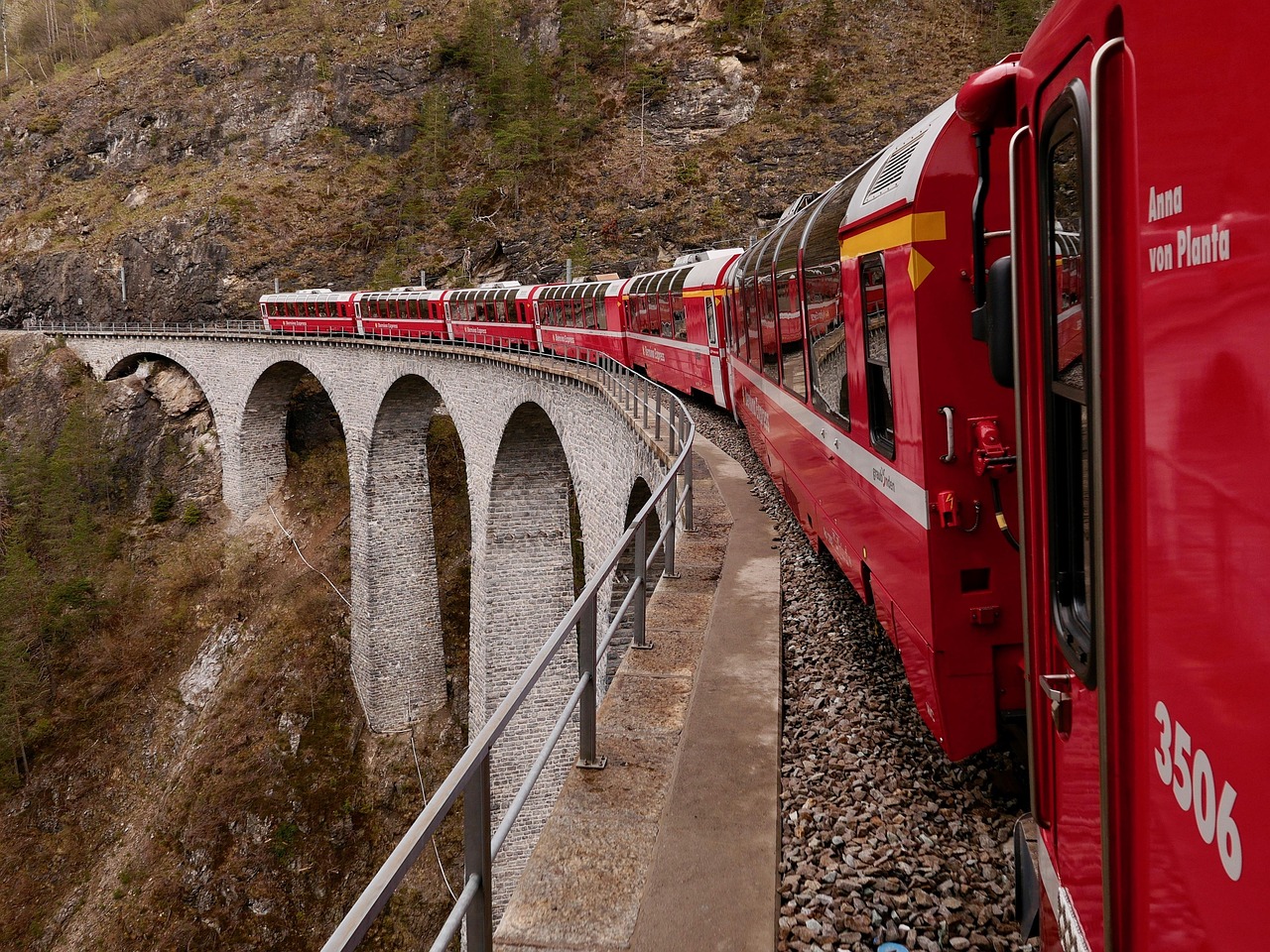
Check Availability on GetYourGuide →The Bernina Express is a panoramic train operated by the Rhaetian Railway (RhB) that crosses the Alps between Switzerland and Italy without a rack-and-pinion system — an engineering feat that earned it UNESCO World Heritage status in 2008, together with the Albula line.
The route connects Chur or St. Moritz in Switzerland with Tirano in northern Italy via the Bernina Pass (2,253 m). The full journey from Chur takes about 4.5 hours; from St. Moritz, around 4 hours. Along the way the train descends nearly 2,000 meters in altitude, passing from a winter alpine landscape into the lush valleys of the Valtellina.
GetYourGuide offers Bernina Express day trips and guided experiences with instant confirmation. Note: if you already hold a Swiss Travel Pass, the seat reservation must be booked directly with the railway operator — contact whoever sold you your pass for details.
View Experiences on GetYourGuide →The journey unfolds in two distinct phases, each with its own character.
If starting from Chur, the train first follows the Albula line through dramatic gorges and spiral tunnels before reaching St. Moritz. From St. Moritz, the Bernina section begins. The train climbs steadily through the Upper Engadine valley, passing lakes like Lej da Champfèr and the Lej Nair, before reaching the glacier landscape near Pontresina. Above Pontresina, the white expanse of the Morteratsch Glacier appears to the right — one of the most striking views of the journey. The train continues to Alp Grüm (2,091 m), where it pauses briefly and passengers often step out to take in the view over the Palü Glacier.
After Ospizio Bernina, the highest point, the landscape begins a dramatic shift. The train descends through rocky highland terrain toward Poschiavo, a charming Italian-speaking Swiss village. South of Poschiavo, the route's most celebrated engineering landmark appears: the Brusio Spiral Viaduct, a circular open viaduct that loops 360° to lose altitude — one of the most photographed railway structures in the world. From there the scenery transforms rapidly into vineyards and Mediterranean vegetation as the train crosses into Italy and arrives at Tirano.
The Bernina Express descends nearly 1,800 metres from its highest point to Tirano — one of the steepest non-rack railway descents in the world. The chart below shows the full elevation profile from St. Moritz to Tirano with all key stops.
| Station | Altitude | Country | Highlight |
|---|---|---|---|
| St. Moritz | 1,822 m | 🇨🇭 | Starting point — famous resort & lake |
| Pontresina | 1,805 m | 🇨🇭 | Gateway to Diavolezza & Morteratsch Glacier |
| Morteratsch | 1,896 m | 🇨🇭 | Glacier views (sit right side / seat A) |
| Bernina Lagalb | 2,099 m | 🇨🇭 | Lago Bianco & Lago Nero viewpoints |
| Ospizio Bernina ★ | 2,253 m | 🇨🇭 | Highest point — turquoise Lago Bianco |
| Alp Grüm | 2,091 m | 🇨🇭 | Panoramic terrace & Palü Glacier view |
| Poschiavo | 1,014 m | 🇨🇭 | Italian-speaking Swiss town — good lunch stop |
| Brusio 🌀 | 780 m | 🇨🇭 → 🇮🇹 | Spiral viaduct — 360° loop |
| Tirano | 441 m | 🇮🇹 | End point — Santuario della Madonna, local food |
For the St. Moritz → Tirano direction:
In practice, both sides offer outstanding scenery. The panoramic roof windows of the dedicated Bernina Express cars mean you can see upward too, which makes the difference between sides less critical than on other trains.
The Bernina Express runs year-round, but each season has a different character:
GetYourGuide offers guided day-trip packages to the Bernina Express that include transfers, making it easy to experience the route without planning every connection yourself.
Browse Day Trip Options →The Bernina Express panoramic cars require a mandatory seat reservation (CHF 14–25 depending on season) in addition to a valid rail ticket. If you hold a Swiss Travel Pass, it covers the base fare — you still need to add a seat reservation, which must be arranged through whoever issued your pass or at a Swiss train station.
Alternatively, the same scenic route can be travelled on regular regional trains (IR/RE services) without a reservation, though these use standard cars without panoramic windows.
Most travellers do the route one-way and return by a different means (bus or train via Lugano and the Gotthard). Doing it return on the same day is possible but makes for a long day (roughly 8 hours on the train). A popular combination is to travel one-way and spend a night in Poschiavo or Tirano before returning.
ℹ️ Several of the answers below depend on your specific ticket or tour package. Always check the conditions of your booking before travelling.
It depends on how you book. On the official Bernina Express panoramic service, a seat reservation is mandatory and your specific seat is assigned. If you book a guided day trip or experience through a platform like GetYourGuide, check the confirmation — some packages include a reserved panoramic seat, others may use regular regional trains where seats are not reserved. Always read the conditions of what you purchased.
The Swiss Travel Pass covers the base fare on the Bernina Express — but only if you book directly through the official RhB or SBB website. You still pay a seat reservation supplement (CHF 14–25). If you book via GetYourGuide or another third-party platform, the Swiss Travel Pass is not applicable, as those packages include their own ticket. Check your booking confirmation if you are unsure.
It depends on where you board. From St. Moritz to Tirano: approximately 4 hours. From Chur (including the Albula line): approximately 4.5 hours. If you join a guided tour that starts in Milan and travels by coach to Tirano first, your total day will be considerably longer — check the itinerary of your specific experience. Times can also vary slightly by season.
This depends on your ticket type. With a standard point-to-point ticket or a rail pass, you can generally break the journey at any station and continue on a later train (you would need a new seat reservation for the next Bernina Express service). If you purchased a guided tour or a packaged experience, getting off independently may not be part of the itinerary — check your booking conditions before planning any stops.
The standard Bernina Express panoramic service includes a minibar trolley (snacks, sandwiches, drinks). There is no full dining car. Some guided tour packages include a lunch stop in Poschiavo or Tirano — check the details of your specific experience. The station at Alp Grüm also has a small restaurant where trains briefly stop.
The route is scenic in every season, but each has its character. Summer (June–September) is the most popular: vivid glaciers, turquoise lakes, alpine flowers — and the most demand for seats. Autumn (October) brings fewer crowds and golden larches. Winter is magical in snow but can have weather-related delays. Spring is the quietest period with good availability. If you're flexible, shoulder seasons (May or October) offer a good balance of scenery and availability.
The Bernina Express crosses the border between Switzerland and Italy. Both countries are part of the Schengen Area, so there are normally no passport checks on board. However, if you are a non-EU/non-EEA citizen, you should always carry your passport when crossing international borders, even within Schengen. Check the entry requirements for both Switzerland and Italy based on your nationality before travelling.
The journey descends nearly 2,000 metres in altitude from the Swiss Alps to the Italian valley of Tirano. If you start in St. Moritz (1,822 m) on a cool morning, it can be considerably warmer by the time you arrive in Tirano. Dress in layers. Luggage space in the panoramic cars is limited — large suitcases can be difficult to manage. For photographs, a lens cloth helps with window glare, and a wide-angle setting works well for the panoramic views.
The Bernina Express has limited accessibility at some smaller intermediate stations. The panoramic cars have step-free boarding at main stations. If you have mobility requirements, check the conditions of your specific booking and contact whoever sold you the ticket — whether that is GetYourGuide, a travel agent, or the railway operator directly — to confirm what is possible on your journey.