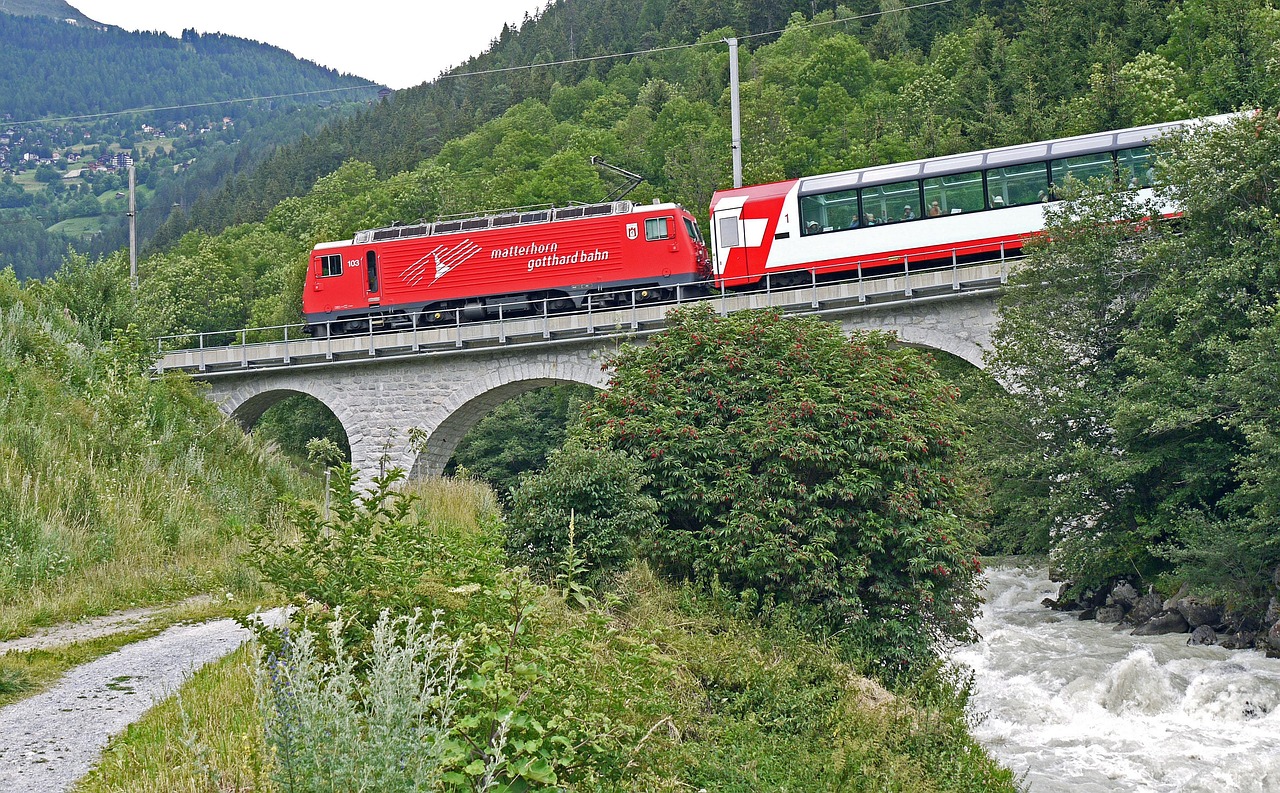
8 hours, 291 bridges, 91 tunnels — from the car-free village of Zermatt to the glamorous resort of St. Moritz across the heart of the Swiss Alps.
Check Availability on GetYourGuide →The Glacier Express is a panoramic train operated jointly by the Matterhorn Gotthard Bahn (MGB) and the Rhaetian Railway (RhB). It runs daily between Zermatt and St. Moritz — or Davos during part of the year — crossing three Alpine passes and passing through some of the most dramatic mountain scenery in Europe.
Despite being called an "express," it is famously one of the slowest long-distance trains in the world. The 8-hour journey is entirely intentional: the route winds through narrow valleys, over high viaducts, and through mountain tunnels at a pace designed for scenery, not speed. The train crosses 291 bridges, passes through 91 tunnels, and reaches a maximum altitude of 2,033 m at the Oberalp Pass — making it one of the highest rail crossings in the Alps.
First inaugurated in 1930, the Glacier Express has become one of the most iconic rail journeys in the world. Today it carries hundreds of thousands of passengers every year, drawn by the combination of engineering marvels, alpine scenery, and the comfort of the modern panoramic cars introduced in 2016.
GetYourGuide offers Glacier Express experiences and day trips with instant confirmation. Check the specific conditions of each offer — seat guarantee, Swiss Travel Pass compatibility, and meal inclusions vary by package.
View Experiences on GetYourGuide →The journey begins in Zermatt, the car-free village beneath the Matterhorn. As the train climbs out of the valley, the iconic pyramid of the Matterhorn appears behind you — look back for the best view in the first few minutes. The train follows the Matter Valley north through Visp, then turns east into the Rhône Valley and climbs toward Brig. From Brig, the route enters the Goms valley — a high, wide alpine plateau lined with traditional wooden villages and, in winter, completely blanketed in snow. The train passes through Fiesch, home to the Aletsch Glacier (the longest in the Alps), before ascending to the Furka Base Tunnel and emerging near Andermatt, a crossroads village beneath the Gotthard massif.
This is the highest section of the journey. From Andermatt the train climbs to the Oberalp Pass at 2,033 m — the highest point on the route — where the landscape is bare, windswept, and extraordinary in its starkness. In winter this section is particularly dramatic, with the train cutting through walls of packed snow several metres high. After the pass, the train descends into the Vorderrhein valley and arrives at Disentis/Mustér, a small town in the Romansh-speaking Graubünden, where a Benedictine monastery with roots going back to the 8th century is visible on the hillside above the station.
From Disentis, the Rhaetian Railway takes over and the train continues through the Rhine gorge — the so-called Swiss Grand Canyon — a dramatic stretch of steep rocky walls carved by the Rhine River. This section between Ilanz and Reichenau is one of the lesser-discussed highlights of the route, often overlooked because passengers are coming off the high-altitude drama of the Oberalp Pass. After Chur (the oldest city in Switzerland, with a well-preserved medieval old town), the train climbs the famous Albula line via spiral tunnels and stone viaducts — including the celebrated Landwasser Viaduct near Filisur — the same UNESCO-listed section used by the Bernina Express. The journey ends in St. Moritz in the late afternoon, with the frozen lake or summer meadows of the Engadin valley spread below.
The Glacier Express descends from Zermatt, drops all the way to Visp, climbs again to the Oberalp Pass, and finally rises once more to St. Moritz. This profile — far more varied than a straight mountain crossing — is what makes the journey so visually rich.
| Station | Altitude | Highlight |
|---|---|---|
| Zermatt | 1,604 m | Departure — Matterhorn views looking back |
| Visp | 661 m | Lowest point; connection to Interlaken/Bern |
| Brig | 681 m | Entry to the Goms valley |
| Fiesch | 1,049 m | Gateway to the Aletsch Glacier |
| Andermatt | 1,444 m | Mountain village; Gotthard crossroads |
| Oberalp Pass | 2,033 m | Highest point — open alpine plateau |
| Disentis/Mustér | 1,130 m | Benedictine monastery (8th century) |
| Ilanz → Reichenau | ~700 m | Rhine Gorge (Swiss Grand Canyon) |
| Chur | 596 m | Oldest city in Switzerland |
| Filisur | 1,032 m | Landwasser Viaduct (UNESCO) |
| Bergün/Bravuogn | 1,367 m | Albula spiral tunnels begin |
| St. Moritz | 1,822 m | Arrival — Engadin valley terminus |
As the train pulls out of Zermatt station and rounds the first bend, the Matterhorn's unmistakable pyramid appears behind you to the south. This lasts only a few minutes before the valley closes in — have your camera ready from the moment the train departs. It is the most photographed moment of the journey, and rightly so.
Between Brig and Andermatt, the train crosses the Goms — a broad, flat-bottomed valley at around 1,300–1,400 m altitude. In winter, the entire valley is buried under deep snow, with traditional wooden chalets and village churches emerging from white fields. The light here, especially on clear mornings, is unlike anything else in Switzerland. In summer, the same valley is green and pastoral, dotted with wildflowers.
At 2,033 m, the Oberalp Pass is the crown of the journey. There is no station stop here — the train simply slows as it crosses the pass, giving passengers time to take in the treeless, wind-scoured plateau and the dark blue waters of the Oberalpsee. In winter, snow walls several metres high line the track, and the train passes through them at walking pace.
Between Ilanz and Reichenau — after the train has descended from the Oberalp Pass and is making its way toward Chur — the route enters the Rhine Gorge, a narrow canyon of white limestone walls carved by the Vorderrhein. This section is often called the "Swiss Grand Canyon" and is a genuine geological spectacle. It is one of the most under-appreciated highlights of the entire journey.
On the Albula section between Chur and St. Moritz, the train crosses the Landwasser Viaduct near Filisur — a six-arched stone viaduct curving at 65 m height directly into the mouth of a tunnel. It is one of the most photographed railway structures in the world and part of the UNESCO-listed Rhaetian Railway. The viaduct is best seen from the right side of the train travelling in the Chur → St. Moritz direction.
For the Zermatt → St. Moritz direction:
The panoramic cars have large windows that extend into the roof, so the view is good from either side throughout the journey. The differences above are for specific landmark moments. Both sides see the Oberalp Pass and the Goms valley clearly.
Unlike the Bernina Express, the Glacier Express has a full dining car — one of its most distinctive features. A three-course lunch is served at your seat (or in the dining car), and the train is well-known for its tilted wine glasses, a design quirk invented to compensate for the steep gradients on the route. The glasses have angled bases that keep the liquid level even as the train climbs or descends. This has become one of the symbols of the Glacier Express experience.
The menu changes seasonally and typically features Swiss-influenced dishes. Whether a meal is included in your booking depends on your ticket or tour package — check the conditions of your specific experience. On some packages it is included; on others it is an add-on or can be purchased on board.
These are Switzerland's two most famous panoramic trains, and both depart from (or arrive at) St. Moritz. The question of which one to take — or whether to do both — is one of the most common questions from first-time visitors to Switzerland.
| Glacier Express | Bernina Express | |
|---|---|---|
| Route | Zermatt ↔ St. Moritz | St. Moritz ↔ Tirano (Italy) |
| Duration | ~8 hours | ~4 hours |
| Highest point | Oberalp Pass — 2,033 m | Ospizio Bernina — 2,253 m |
| Dining car | Yes — full table service | No — café bar only |
| Countries crossed | Switzerland only | Switzerland and Italy |
| UNESCO status | No (Albula section is) | Yes (Rhaetian Railway) |
| Reservation | Mandatory | Recommended |
| Best for | Full-day Alpine immersion, dining, Matterhorn | Half-day, Italy connection, Brusio spiral |
If you can only choose one and have a full day free, the Glacier Express offers more variety and the unique dining experience. If you want to cross into Italy or complete the journey in half a day, the Bernina Express is the better fit. Many travellers do both — they make natural complements, sharing St. Moritz as a connection point.
St. Moritz is the junction between the two routes. A classic Swiss rail itinerary uses this to build a loop across the Alps:
This four-day loop gives you the Matterhorn, the Oberalp Pass, the Engadin, the Bernina pass, and a corner of northern Italy — all by train, without a car.
A seat reservation is mandatory for the Glacier Express panoramic cars. If you hold a Swiss Travel Pass or Eurail/Interrail pass, these cover the base fare but the reservation supplement must be arranged through whoever issued your pass — check with your ticket provider for the correct process.
Because the journey takes a full day in each direction, most travellers do it one-way and travel back by a different route (e.g. via Zurich by InterCity from Chur). A popular multi-day itinerary combines the Glacier Express one way with the Bernina Express the other, using St. Moritz as the connection point — see the suggested itinerary above.
Storage space in the panoramic cars is limited. Travel with cabin-sized luggage if possible. If you need to transport large bags, SBB offers a luggage forwarding service (Gepäck) that sends your suitcase to your destination ahead of time — useful if you are spending a night at either end of the route.
GetYourGuide has guided experiences in both Zermatt and St. Moritz — consider adding a guided activity at either end of your Glacier Express journey.
Browse Experiences on GetYourGuide →ℹ️ Several answers below depend on your specific ticket or tour package. Always check the conditions of your booking before travelling.
On the official Glacier Express panoramic service, a seat reservation is mandatory and your seat is assigned. If you purchased a guided tour or packaged experience, check your booking confirmation — some packages include a reserved panoramic seat, while others may use different rolling stock. Contact whoever sold you the ticket if you are unsure.
Rail passes (Swiss Travel Pass, Eurail, Interrail) cover the base fare but not the mandatory seat reservation supplement. The reservation must be arranged through whoever issued your pass. If you book via GetYourGuide, those packages are standalone and pass discounts do not apply — check the specific offer details.
The full journey between Zermatt and St. Moritz takes approximately 8 hours. Some packages may cover only a portion of the route (e.g. Zermatt to Andermatt or Andermatt to St. Moritz). Always check the start and end points of your specific booking.
With a standard rail ticket or pass, you can generally break the journey at any station and continue on a later service (a new seat reservation would be needed). If you purchased a guided tour or packaged day trip, stopping independently may not be included — check the itinerary and conditions of your specific experience.
Yes — unlike the Bernina Express, the Glacier Express has a full dining car with seated table service. A seasonal three-course lunch menu is available. The train's tilted wine glasses, designed to keep drinks level on steep gradients, have become one of its signature features. Whether a meal is included in your booking depends on your ticket or package; it is an add-on for some and included for others.
Yes. The Glacier Express uses the Albula line between Chur and St. Moritz, which includes the famous Landwasser Viaduct near Filisur. This UNESCO-listed viaduct is also used by the Bernina Express — it is the same piece of track, shared by both services. Sit on the right side of the train (travelling Chur → St. Moritz) for the best view.
Yes — this is one of the most popular Swiss rail itineraries. Both trains meet at St. Moritz. A classic approach is to take the Glacier Express from Zermatt to St. Moritz one day, stay overnight, then take the Bernina Express south to Tirano (Italy) or Lugano the following day. The reverse direction works equally well.
The route is scenic year-round. Summer (June–September) is most popular, with green valleys and clear views — seats fill up fast. Autumn brings golden larches and fewer crowds. Winter is dramatic in deep snow but the Oberalp section can have weather delays. Spring is the quietest and most affordable season.
Dress in layers — the train is heated, but temperatures at the Oberalp Pass (2,033 m) can differ significantly from Zermatt or St. Moritz at valley level. Luggage space is limited in the panoramic cars so travelling light is advisable. A microfibre cloth reduces window reflections for photography. Binoculars are useful for spotting distant peaks and glaciers.
The 8-hour journey is long for young children, but the constantly changing scenery and the novelty of the dining car tend to keep older children engaged. Children under 6 travel free on Swiss railways with a family card (not applicable to all tour packages). If travelling with young children, consider doing only a section of the route rather than the full day journey.
The Glacier Express has adapted seating areas and step-free boarding at major stations. Some smaller intermediate stops have limited accessibility. If you have specific mobility requirements, check the conditions of your booking and contact whoever sold you the ticket to confirm what assistance is available on your specific journey.