Glaciers, ice caves, and 360° views of the Alps — a journey to the roof of Europe from Interlaken or Grindelwald.
Check Availability on GetYourGuide →Jungfraujoch — officially marketed as "Top of Europe" — is the highest railway station in Europe, sitting at 3,454 metres above sea level in the Bernese Alps. It is located on the saddle between the Jungfrau (4,158 m) and the Mönch (4,107 m), two of the most iconic peaks in the Swiss Alps.
The station and visitor complex are carved directly into the rock and ice of the mountain. From here you have access to the Aletsch Glacier — the longest glacier in the Alps at over 23 km — as well as observation terraces, ice caves, a research station, and on clear days, a panorama that stretches to the Black Forest in Germany and Mont Blanc in France.
Unlike most high-altitude destinations in the Alps, Jungfraujoch requires no hiking and no ski equipment. The Jungfrau Railway takes you all the way from the valley floor to the mountain saddle — a feat of engineering that took 16 years to build and opened in 1912.
GetYourGuide offers Jungfraujoch day trips from Interlaken, Zurich, Lucerne and other cities — with guided options that handle all connections. Check the conditions of each offer for what is included.
View Experiences on GetYourGuide →The idea of building a railway to the Jungfraujoch was conceived by Swiss entrepreneur Adolf Guyer-Zeller in 1893. The plan seemed almost impossible: drill nearly 8 km of tunnel through the solid rock of the Eiger and Mönch to reach the saddle at 3,454 m, using only the technology available in the 1890s.
Construction began in 1896 and took 16 years, finally opening on 1 August 1912 — Swiss National Day. It was one of the most complex construction projects in alpine history. The railway was electric from the start, powered by a dedicated hydroelectric plant, which was unusual for the era. Today it remains the highest rack railway in Europe and carries around a million visitors a year.
Two intermediate stations were built inside the tunnel: Eigergletscher (2,320 m) and Eismeer (3,160 m), where the train pauses to allow passengers to look out through windows cut into the rock face — one of the strangest and most memorable moments of the ascent.
There is no road to Jungfraujoch — the only way up is by train. The journey involves two or three changes depending on your starting point, but all connections are coordinated and easy to follow.
The most common starting point. Trains depart regularly and the journey takes approximately 2 hours each way. The route goes: Interlaken Ost → Grindelwald or Lauterbrunnen → Kleine Scheidegg → Jungfraujoch. At Kleine Scheidegg (2,061 m) you transfer to the Jungfrau Railway for the final ascent — a steep tunnel through the Eiger, with the famous stops at Eigergletscher and Eismeer on the way.
A faster alternative introduced in 2020. The Eiger Express gondola runs from Grindelwald Terminal directly to Eigergletscher in about 15 minutes, dramatically cutting travel time compared to the traditional train route via Grindelwald. From Eigergletscher, the Jungfrau Railway completes the ascent. This route can save 45–60 minutes each way, and the gondola itself offers spectacular aerial views of the Grindelwald glacier valley. Check your specific booking for conditions and inclusions.
Both villages are valid starting points and reduce the journey time slightly compared to starting from Interlaken. Many visitors choose to spend a night in Grindelwald or Lauterbrunnen and make the Jungfraujoch ascent as a morning trip — this also means you are already in the mountains, which gives you earlier access to the first trains up.
| Station | Altitude | Note |
|---|---|---|
| Interlaken Ost | 568 m | Main departure point from the valley |
| Grindelwald | 1,034 m | Village base; transfer to BOB or Eiger Express |
| Kleine Scheidegg | 2,061 m | Transfer to the Jungfrau Railway; views of the Eiger North Face |
| Eigergletscher | 2,320 m | First tunnel station; Eiger Express gondola arrives here |
| Eismeer | 3,160 m | Window into the glacier from inside the mountain — brief stop |
| Jungfraujoch | 3,454 m | Top of Europe — terminus and visitor complex |
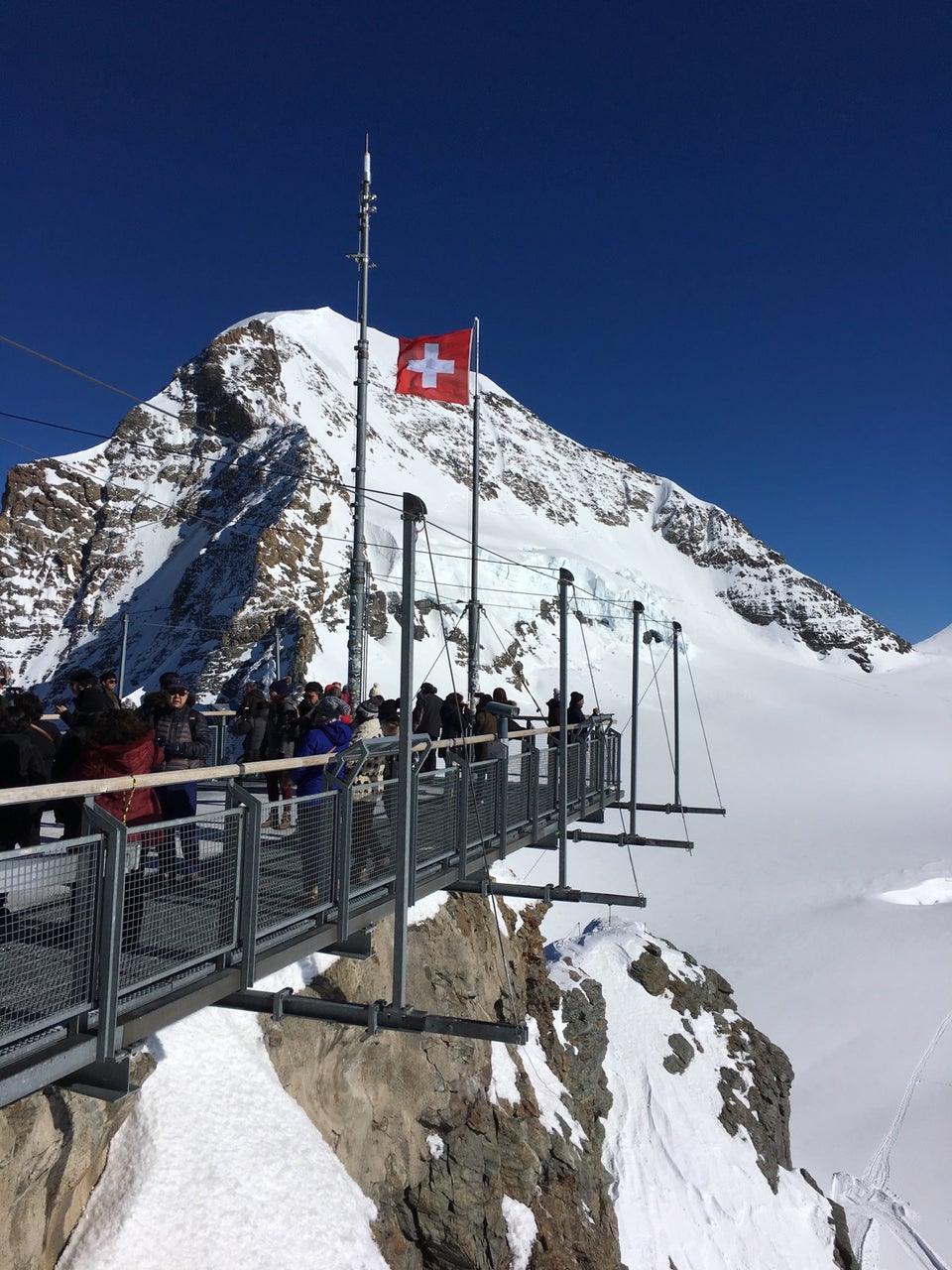
The outdoor observation deck at 3,571 m is the highest accessible point of the complex, reached by a lift from the station. On a clear day the panorama is extraordinary — the Aletsch Glacier flowing south into the distance, the peaks of the Eiger (3,967 m), Mönch (4,107 m), and Jungfrau (4,158 m) surrounding you, and on the best days, the horizon stretching to Mont Blanc and the Black Forest. Wind can be intense even in summer — bring a windproof jacket even if the valley below is warm.
The Aletsch Glacier — 23 km long and up to 900 m deep — is the largest glacier in the Alps and a UNESCO World Heritage Site. It is visible from the outdoor terrace as a vast slow-moving river of blue-white ice descending south toward the Rhône valley. The glacier has been receding visibly over recent decades; scientists at the Sphinx research station have been monitoring it since 1931. What you see today is significantly smaller than a century ago, making a visit both spectacular and sobering.
Tunnels carved inside the glacier itself, decorated with ice sculptures and lit by a blue-white glow that filters through the ice. The temperature inside is around −3°C year-round — it does not matter what season you visit. Access is included in most standard visit packages. The Ice Palace is one of the most popular attractions at the top, particularly with families and children.
One of the strangest moments of the journey up happens before you arrive at the top. At Eismeer station (3,160 m), the Jungfrau Railway stops for several minutes and passengers can step out onto a platform inside the mountain and look through windows cut into the rock face — directly onto the glacier below. The view is surreal: the outside world visible through a hole in the mountain, the air bitterly cold, the glacier shockingly close. This is often the moment that catches visitors most off-guard.
The visitor complex includes an interactive walk through the history of the Jungfrau Railway — a tunnel installation with audio, light, and photographs documenting the 16-year construction. The Lindt shop and chocolate tasting area is popular with families and makes for a warm break after the outdoor terrace.
In the area outside the complex (weather and snow conditions permitting), there are short ski and sledge runs, a zip line, and a snow plateau where you can walk directly onto the glacier surface. Conditions and inclusions vary by season and by the package you purchased — check your specific booking for what is available during your visit.
Guided day trips from major Swiss cities handle all train connections and include a visit to Jungfraujoch — ideal if you want a seamless experience without planning each transfer.
Browse Day Trips on GetYourGuide →A Jungfraujoch visit from Interlaken takes a full day. Here is a typical itinerary:
Jungfraujoch is the most dramatic destination in the region but not the only one. If you have more than one day, these are worth adding:
A gondola from Grindelwald village ascends to First (2,168 m), where a cliff walk, suspension bridge, and hanging metal walkway are cantilevered above a sheer drop with views of the Wetterhorn and Schreckhorn. Less crowded than Jungfraujoch, dramatically scenic, and significantly cheaper. A zip line and mountain cart descend back toward the village for the adventurous.
Reachable by gondola from Wengen or Grindelwald, Männlichen (2,230 m) offers one of the best unobstructed views of the Eiger, Mönch, and Jungfrau side by side. The walk from Männlichen to Kleine Scheidegg (about 1.5 hours, easy, flat) is one of the most popular hikes in the Alps, with the three iconic peaks in view the entire time.
Above Lauterbrunnen via Mürren, the Schilthorn (2,970 m) is home to Piz Gloria — the revolving restaurant made famous in the 1969 James Bond film On Her Majesty's Secret Service. The Bond theme runs through the entire visitor experience. Views cover 200 peaks, from Mont Blanc to the Black Forest. A cheaper and less crowded alternative to Jungfraujoch.
A short funicular ride from Interlaken climbs to Harder Kulm (1,322 m), where the famous Two Lakes Bridge cantilevers over a cliff with a view of the Brienz and Thun lakes flanking the valley, and the entire Jungfrau massif in the background. The best sunset viewpoint in the Interlaken area, and very easy to combine with a half-day in town.
At 3,454 m, some visitors experience mild altitude symptoms: headache, dizziness, shortness of breath, or nausea. These are normal and usually pass after 30–60 minutes. Drink water, move slowly on arrival, and avoid heavy exertion. People with serious heart or respiratory conditions should consult a doctor before visiting. Children generally adapt well, but monitor how they feel.
Even in the height of summer, the temperature at Jungfraujoch is typically between −5°C and +3°C, with strong winds on the outdoor terrace. Bring a warm jacket, gloves, and a hat regardless of conditions in the valley below. Sunglasses and sunscreen are essential — UV radiation at altitude is far stronger than at sea level, and snow reflection amplifies it further. Comfortable waterproof shoes are advised for the Snow Fun Park area.
Jungfraujoch is open year-round. Summer (July–August) is the busiest period with the longest queues and highest prices. Autumn is quieter, with fewer visitors and the larch forests on the lower slopes turning gold in October. Winter visits are magical but temperatures on the outdoor terrace can drop to −15°C or below. The most important factor is weather — always check the Jungfrau region forecast the evening before. A clear morning is worth more than the right season.
ℹ️ Several answers below depend on the specific experience or package you purchased. Always check the conditions of your booking before travelling.
The main visitor complex — including the Sphinx terrace, Ice Palace, Alpine Sensation, and the Lindt area — is generally accessible as part of the admission. The Snow Fun Park outside may have separate conditions depending on season and snow cover. Always check the inclusions of your specific booking before travelling.
The Eiger Express is a large gondola running from Grindelwald Terminal to Eigergletscher (2,320 m), cutting the ascent time significantly compared to the traditional train route. It saves roughly 45–60 minutes each way and the gondola ride itself — gliding over the Grindelwald glacier valley — is impressive. Whether it is included in your package or costs extra depends on your booking.
The Swiss Travel Pass provides a discount on the Jungfraujoch ticket but does not cover the full fare — the Jungfrau Railway section requires an additional payment. The exact discount depends on your pass type. If you purchased a day trip through a third-party platform like GetYourGuide, the Swiss Travel Pass is generally not applicable — check the booking conditions carefully.
The journey from Interlaken takes about 2 hours each way. Most visitors spend 1.5 to 2.5 hours at the top, making the total day trip around 5.5 to 7 hours from Interlaken. If you are on a guided day trip from Zurich or another city, the total day will be longer — check the itinerary of your specific experience.
The average year-round temperature at Jungfraujoch is around −7°C. In summer it can reach −2°C to +3°C on calm days; in winter the outdoor terrace can drop to −15°C or colder with wind chill. The indoor facilities are heated to a comfortable temperature throughout the year. Always bring a warm jacket, gloves, and a hat regardless of the season.
Yes — the complex has a self-service restaurant, a café, and the Lindt shop. Prices are significantly higher than in the valley due to the logistics of supplying the mountain. Whether a meal is included depends on the package you purchased; most standard tickets do not include food. If budget matters, eat at Kleine Scheidegg on the way down — the food is better value and the view of the Eiger directly above is spectacular.
Cloud cover is common in the afternoons, especially in summer. Taking the first train up gives you the best odds of clear views. On fully overcast days the outdoor panorama will be limited, but the Ice Palace, Eismeer window, Sphinx interior, and other facilities inside the complex remain open. Check the mountain weather forecast the evening before your visit. Refund or rebooking conditions in case of bad weather depend entirely on your booking.
Yes — Jungfraujoch is popular with families. Children generally handle the altitude well, though watch for signs of discomfort (headache, tiredness, loss of appetite). The Snow Fun Park, Ice Palace, and Lindt area are all engaging for children. The train journey itself — including the Eismeer tunnel window — fascinates younger visitors. Children under 6 travel free on Swiss railways with a family card (not applicable to all packages).
There is no developed ski resort at Jungfraujoch itself. The Snow Fun Park has short ski and sledge runs suited to beginners and children, but experienced skiers looking for proper terrain should look at the slopes of Grindelwald-First or the wider Jungfrau Ski Region (Grindelwald, Wengen, Mürren). The Schilthorn and First are better bases for serious skiing in the region.
The main areas of the visitor complex — the Sphinx terrace lift, Ice Palace, and the indoor facilities — are largely accessible via lifts and flat corridors. The Snow Fun Park outdoor area is less suitable for limited mobility. If you have specific requirements, check the conditions of your booking and contact whoever sold you the ticket to confirm what is available on your visit.