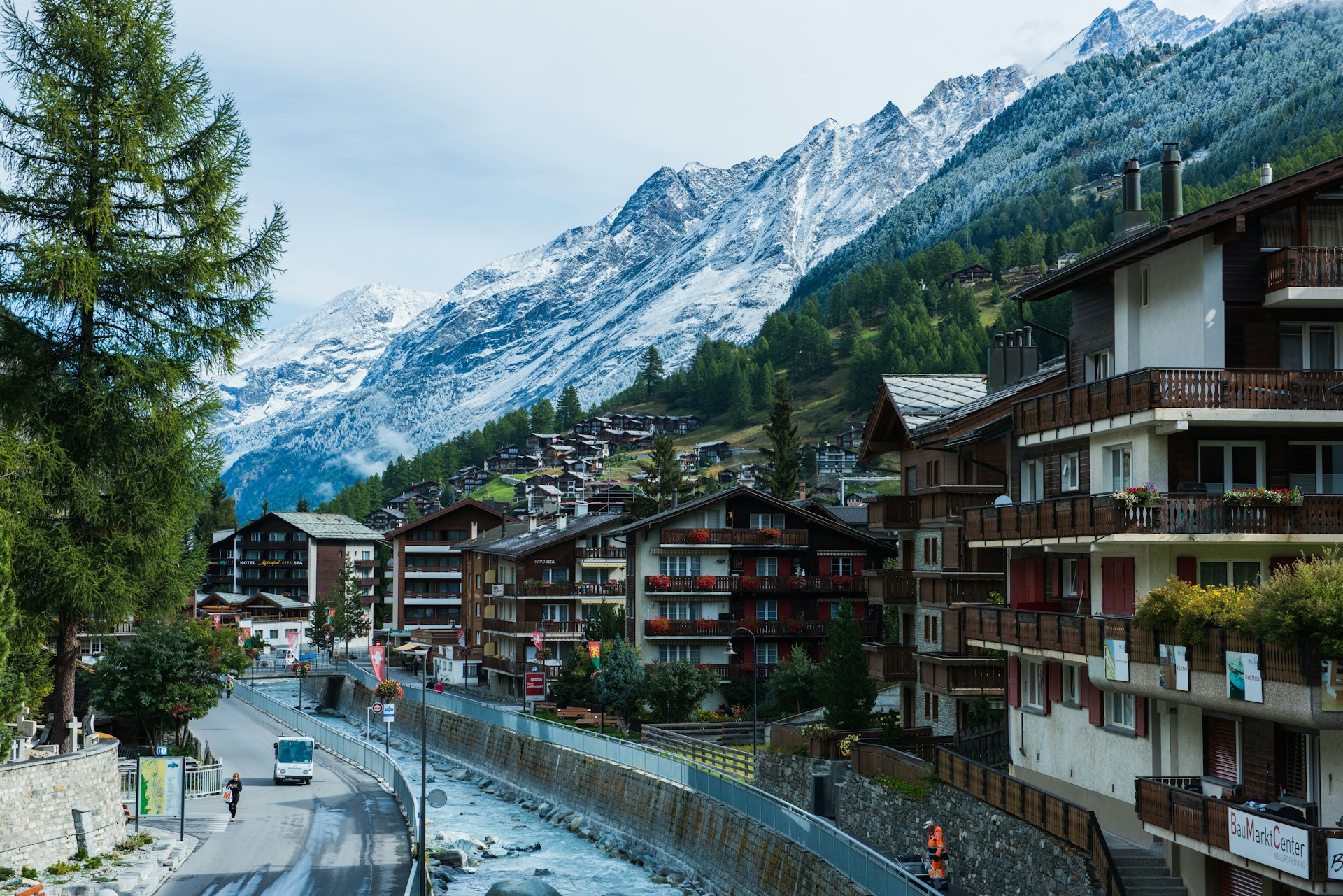
A car-free alpine village at the foot of Switzerland's most iconic peak — the starting point of the Glacier Express and one of the great mountain destinations in the world.
Explore Zermatt on GetYourGuide →Zermatt is a small alpine village in the canton of Valais, sitting at 1,604 m in the narrow Mattertal valley. It has been car-free since 1930 — no private petrol or diesel vehicles are allowed in the village. The streets are shared by electric taxis, horse-drawn carriages, and pedestrians, giving Zermatt a quieter, cleaner atmosphere than most mountain resorts of its size.
The village sits directly beneath the Matterhorn (4,478 m) — one of the most recognisable mountain silhouettes in the world. The peak's four-sided pyramid shape, visible from the end of Zermatt's main street, is the defining image of the place. It appears on Swiss chocolate packaging, watches, and postcards, but nothing quite prepares you for seeing it in person.
Zermatt is also the western terminus of the Glacier Express — the panoramic train that crosses the Alps to St. Moritz in 8 hours. For many visitors, arriving in Zermatt is the beginning of a larger Swiss rail journey.
GetYourGuide offers guided tours, ski passes, snowshoe walks, and day trips from Zurich and Geneva — with instant confirmation and clear booking conditions.
View Experiences on GetYourGuide →The Matterhorn stands at 4,478 m on the border between Switzerland and Italy. Its near-perfect pyramidal shape is the result of glacial erosion on all four faces over millions of years. It was one of the last major Alpine peaks to be climbed — the first ascent came on 14 July 1865, when Edward Whymper and a party of seven reached the summit. Four of the seven died on the descent, in one of the most famous tragedies in mountaineering history.
Today the Matterhorn is climbed regularly by experienced alpinists via the Hörnli Ridge, but it remains a serious technical challenge. For most visitors, the mountain is something to look at, walk toward, and photograph — which it rewards generously from almost every angle in the valley.
The best viewpoints from Zermatt itself are the Riffelalp and Riffelberg (accessible by the Gornergrat Railway), the Schwarzsee cable car, and simply the end of Bahnhofstrasse — Zermatt's main street — where the Matterhorn frames the view up the valley on clear days.
Zermatt has three separate lift systems ascending different sides of the surrounding mountains, each offering distinct scenery and activities.
The Gornergrat Railway (GGB) is the highest open-air rack railway in Europe, climbing from Zermatt (1,604 m) to the Gornergrat summit (3,089 m) in about 33 minutes. The journey itself — with the Matterhorn growing behind you as you ascend — is one of the highlights. At the top, the panorama takes in 29 four-thousanders, including Monte Rosa (4,634 m), the highest peak entirely in Switzerland, and the vast Gorner Glacier below. The summit has a hotel, a terrace, and a small observatory. Sunset and sunrise trips are popular when rooms at the summit hotel are available.
The cable car system from Zermatt ascends via Furi, Trockener Steg, and Matterhorn Glacier Paradise — the highest cable car station in the Alps at 3,883 m. At the top, a panorama platform overlooks Switzerland, Italy, and France simultaneously. On the clearest days you can see Mont Blanc. Year-round skiing begins at this altitude — the Plateau Rosa glacier is open for skiing even in summer. An ice grotto at the summit (carved inside the glacier) is included in the cable car ticket.
The third system ascends to the east via an underground funicular to Sunnegga (2,288 m), then a gondola to Blauherd (2,571 m) and a cable car to Rothorn (3,103 m). This side of the valley is the starting point for the Five Lakes Walk and has a more relaxed character than the busier Matterhorn Glacier Paradise. The Leisee lake near Sunnegga is the most family-friendly swimming area in the Zermatt area in summer.
One of the most celebrated hikes in the Alps. The walk connects five alpine lakes — Stellisee, Grindjisee, Grünsee, Moosjisee, and Leisee — each of which reflects the Matterhorn on calm days. The route starts from Blauherd (reached by gondola from Sunnegga) and descends back to Zermatt over about 3–4 hours. Difficulty is easy to moderate. The Stellisee reflection of the Matterhorn is the most photographed shot in Zermatt, taken in the early morning before wind ripples the surface.
A short and easy walk (30–45 minutes) through a narrow gorge carved by glacial meltwater, just outside the village. Wooden walkways and bridges take you through the chasm. Open in summer only and one of the best-value activities in Zermatt — a small entry fee gives access to one of the more dramatic natural features near the village.
The path from Schwarzsee (reached by cable car) toward the Hörnlihütte — the climbers' hut at the base of the Matterhorn's Hörnli Ridge — is a moderate hike of about 1.5 hours one way. You do not need climbing equipment for this section. The view of the Matterhorn at close range from the hut (3,260 m) is completely different from anything you see in the village — the mountain is no longer a distant pyramid but a wall of rock directly overhead.
Zermatt is one of Switzerland's biggest and most technically demanding ski areas, with 360 km of marked runs spread across three connected massifs. The resort is linked by lift to Cervinia in Italy — on a clear day you can ski from Switzerland into Italy and back. The connection is subject to weather and lift conditions; check before planning a cross-border day.
The ski season typically runs from late October to late April on the main slopes. The Matterhorn Glacier Paradise (3,883 m) is open for summer skiing year-round, making Zermatt one of a handful of resorts in Europe where you can ski in August. The glacier runs are best in the morning before the sun softens the snow.
Off-piste skiing is extensive but requires a guide — the terrain above the marked runs can avalanche, and the scale of the area means self-rescue is not realistic. The resort has a well-developed guiding industry.
Zermatt's main street, Bahnhofstrasse, runs from the train station toward the church and the old village. The street is lined with hotels, watch shops, outdoor gear stores, and restaurants. Despite the tourist density, the village retains a genuine alpine character in its older quarter — narrow lanes with wooden granaries raised on stone mushroom-shaped pillars (mazots), the old cemetery with its mountaineering graves, and the 19th-century church at the centre.
The Matterhorn Museum (Zermatlantis) is built underground beneath the village square and tells the story of Zermatt's transformation from a farming community to an international resort, with extensive coverage of the 1865 first ascent and its tragic aftermath. It is one of the better local museums in the Alps.
Dining in Zermatt covers a wide range — from simple mountain huts (Bergrestaurants) serving rösti and fondue on the slopes, to high-end restaurants in the village with extensive wine lists. The mid-mountain restaurants are often as good as anything in the village itself and significantly cheaper for lunch.
Zermatt is the western departure point of the Glacier Express — the 8-hour panoramic train journey to St. Moritz. Trains depart Zermatt station in the morning (usually around 8:52 AM, but check current timetables) and arrive in St. Moritz in the late afternoon.
If you are planning to take the Glacier Express, arriving in Zermatt a day or two early is highly recommended. The train departs early in the morning, and arriving exhausted the night before from a long journey means you miss the best views of the Matterhorn in the late afternoon light — and the Matterhorn at sunrise the next morning, visible from the train as it pulls away from the station, is one of the signature moments of the whole trip.
From St. Moritz, you can continue on the Bernina Express south to Tirano in Italy — making Zermatt the natural starting point for a classic Swiss Alpine rail loop.
GetYourGuide offers Glacier Express experiences departing from Zermatt — check availability, included meals, and seat reservation conditions before booking.
View Glacier Express Experiences →Private petrol and diesel cars are not permitted in Zermatt. Visitors driving must park at Täsch, the last station with a car park, and take the shuttle train to Zermatt (10 minutes, runs every 20 minutes). Electric vehicles are allowed in Zermatt only for residents and approved operators.
Book guided tours and activities in Zermatt on GetYourGuide — instant confirmation, free cancellation on most bookings.
Browse the full selection of guided tours, activities, and day trips in Zermatt on GetYourGuide — free cancellation on most bookings.
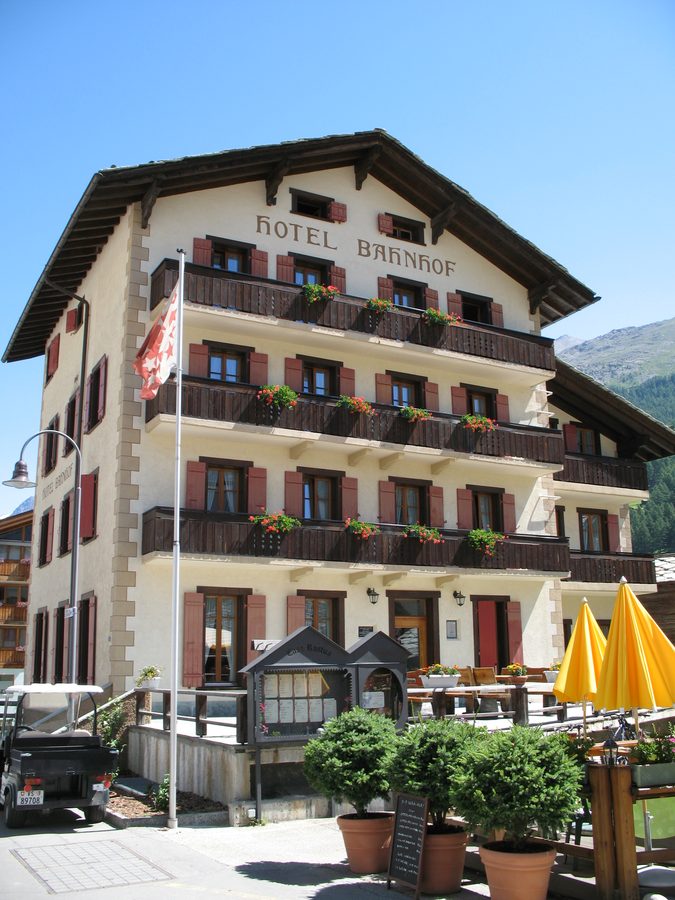
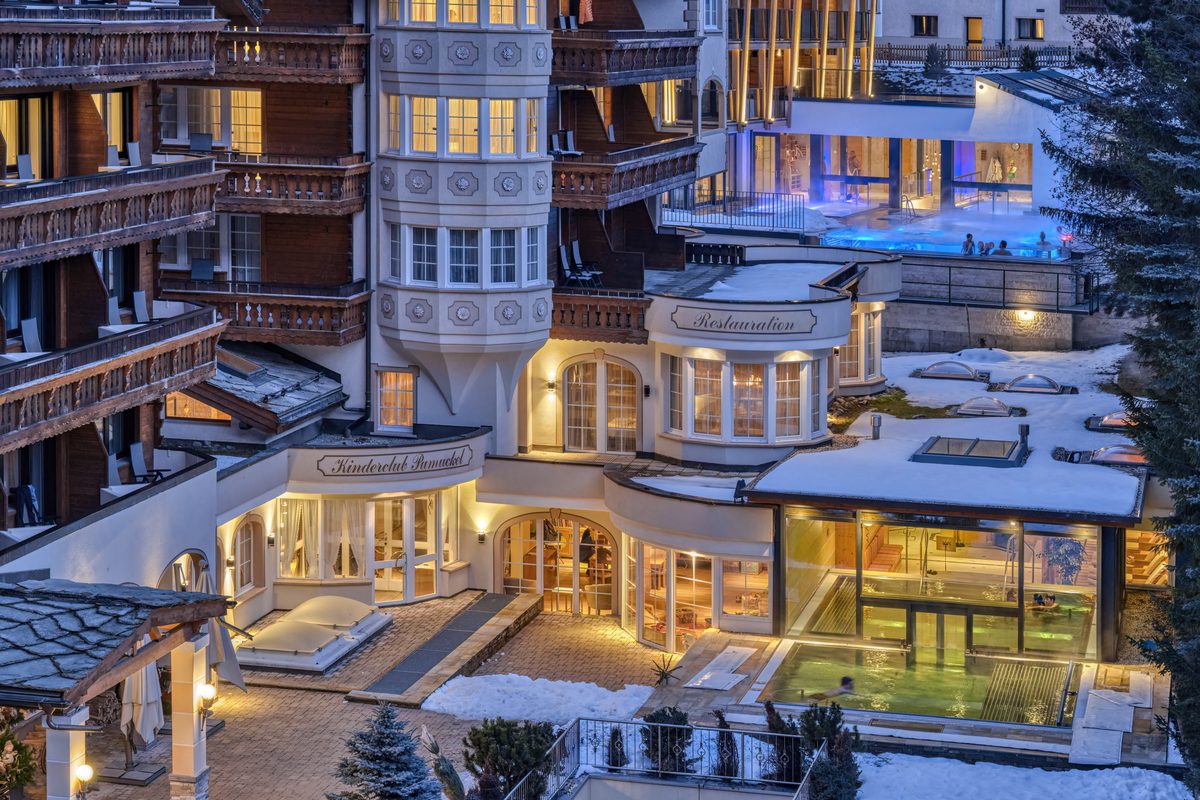
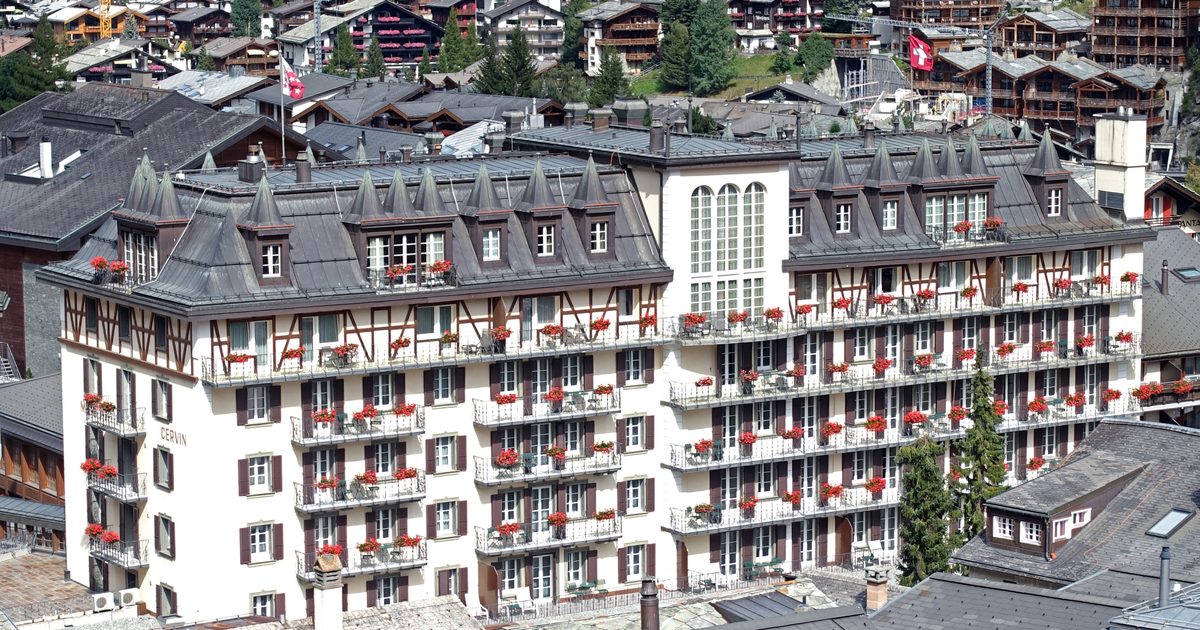
View All Experiences in Zermatt →Zermatt is one of the more expensive places to stay in Switzerland. Prices vary significantly by season — ski season (December–April) and summer peak (July–August) are the most expensive; May, June, and November are quieter and cheaper. For a first visit, stay within walking distance of Zermatt station or the Gornergrat Railway if you want the easiest arrival and morning mountain access.
Compare all available hotels in Zermatt on Klook — filter by price, location, and amenities.
View All Hotels in Zermatt on Klook →No — private petrol and diesel vehicles are not permitted in Zermatt. The last station with public parking is Täsch, about 5 km before Zermatt. A shuttle train (Matterhorn Gotthard Bahn) runs between Täsch and Zermatt every 20 minutes and takes about 10 minutes. Electric vehicles may enter under specific permits, but visitors generally park at Täsch.
Zermatt is worth visiting in any season. Winter (December–April) is peak ski season — busiest and most expensive. Summer (July–August) is warm, the hiking trails are fully open, and the Five Lakes Walk is at its best. Late June and September offer a good balance of clear weather and fewer crowds. May and November are the quietest months with lower prices but some lifts closed for maintenance.
Yes — the Matterhorn is visible from many points in the village, most dramatically at the southern end of Bahnhofstrasse looking up the valley. The view is clearest in the morning before afternoon clouds build. The peak is frequently in cloud from midday onward, particularly in summer. If you want a guaranteed clear view, go up to Gornergrat or Schwarzsee early in the day.
Yes — the Matterhorn Glacier Paradise (Klein Matterhorn, 3,883 m) has year-round skiing on the Plateau Rosa glacier. Summer skiing typically runs from late June to late August, mornings only (the snow softens in the afternoon sun). This is mainly for training and keen skiers; it is not a full resort experience. The main ski area below operates from October to May.
Yes — Zermatt is lift-linked to Cervinia (Breuil-Cervinia) in the Aosta Valley, Italy. On a clear day you can ski between the two resorts. The cross-border connection requires the appropriate lift pass and is subject to weather and lift conditions — it is occasionally closed due to wind or poor visibility. Check conditions on the day. Your ski pass must explicitly include the Italy connection.
There is no direct connection. The most practical route is: Zermatt → Visp (train) → Interlaken Ost (train) → Grindelwald or Lauterbrunnen → Kleine Scheidegg → Jungfraujoch. Total journey is approximately 3.5–4 hours each way, making it a very long day if done from Zermatt. Most people choose to base in Interlaken for Jungfraujoch and in Zermatt for the Glacier Express — they are easier to combine as separate legs of a longer Swiss trip than as a single day.
Absolutely. The Gornergrat Railway runs year-round and provides access to alpine panoramas and snow walks without any skiing. The village itself is attractive in winter — the car-free streets, the fondue restaurants, and the Matterhorn lit by winter sun are all worthwhile. The Gorner Gorge is closed in winter, but most other activities remain accessible. Non-skiers do pay more per activity (cable car tickets add up), but a winter visit to Zermatt without skiing is perfectly rewarding.