The train stops. Italy begins. Here is what to do with the hours between arrival and the return journey north.
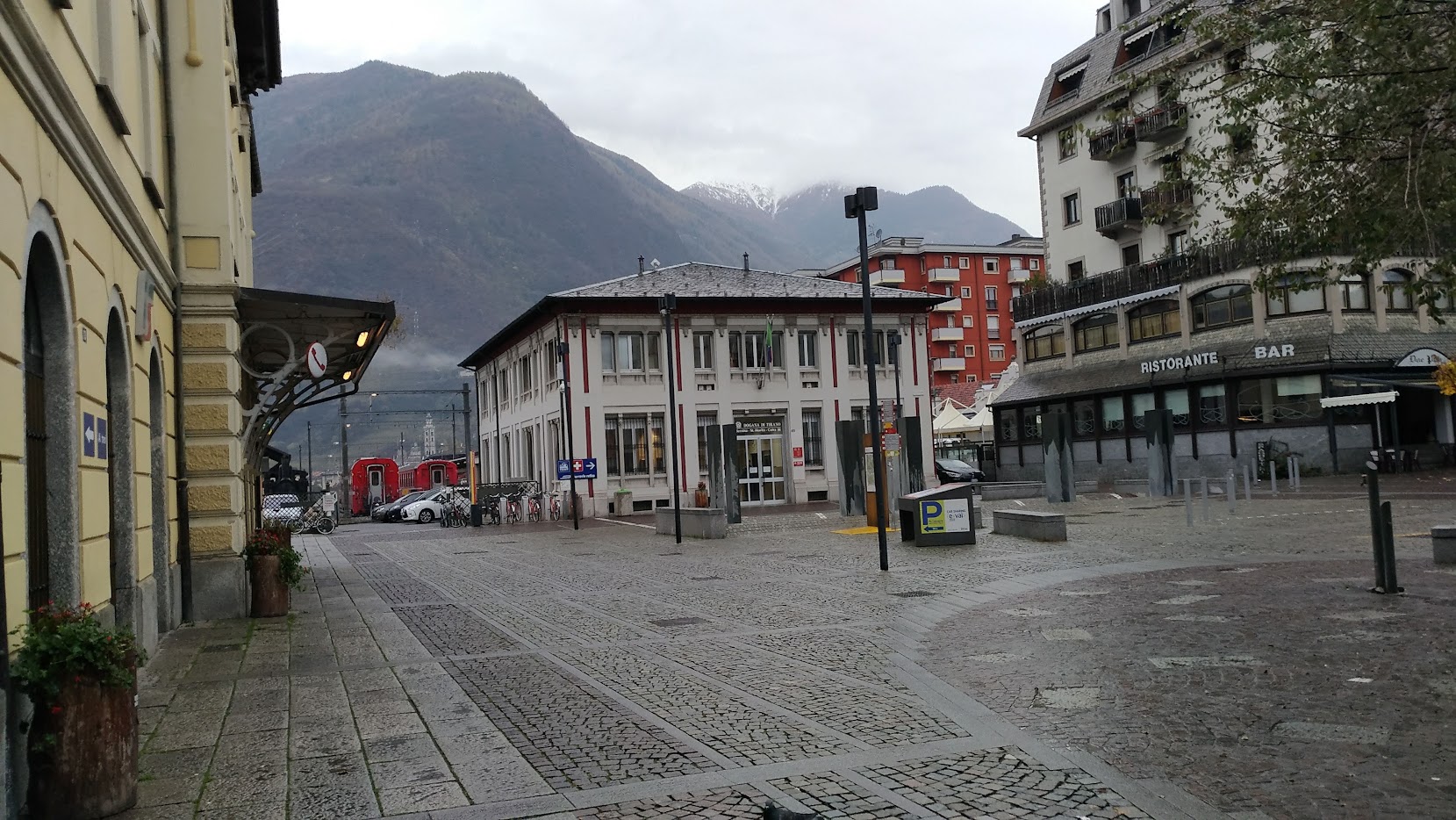
The Bernina Express arrives in Tirano from the Swiss Alps like a quiet announcement. One moment you are above the snowline looking down on glaciers; an hour later the train rolls through the streets of an Italian market town at 429 metres, past café terraces and geranium-filled balconies, the Alps already receding behind you. The transition is one of the most abrupt in European rail travel.
Most passengers who have booked a round-trip turn straight around — buying a coffee on the platform, photographing the Basilica di Madonna di Tirano across the street, and reboarding within the hour. That is understandable but a shame. Tirano rewards the traveller who allows even three or four hours to look around.
The first thing you see stepping off the train is the Basilica di Madonna di Tirano — a Renaissance church of considerable beauty built directly opposite the station entrance. According to local tradition, the Madonna appeared here to a local man named Mario Homodei on 29 September 1504, leaving an imprint on the wall of his house. Construction of the basilica began the following year and continued through the 16th century.
The interior is richly decorated with stucco, frescoes, and a Baroque organ — a striking contrast to the austere Protestant churches of the Swiss valleys the Bernina Express has just passed through. Entry is free; the basilica is open throughout the day. The votive offerings lining the side chapels — silver limbs, painted panels, crutches left by the healed — are a traditional Catholic visual language that has almost vanished from northern Europe.
The Piazza della Basilica outside is where the town's social life concentrates in the morning hours: old men at café tables, market traders unloading on the cobblestones, the occasional tourist from the train looking slightly disoriented by the abruptness of the Italian arrival. Sit down and have an espresso before doing anything else. After hours in a panoramic railway car, it recalibrates you.
Tirano's centro storico (old town) is a 10-minute walk south of the station — a compact grid of medieval lanes, 15th- and 16th-century palaces, and small piazzas. The Palazzo Salis is the most significant building: an aristocratic residence from the 17th century, seat of the Salis family who dominated the upper Valtellina for generations, with frescoed reception rooms and formal Italian gardens visible from the courtyard gate. Guided visits are available by appointment.
The main street, Via Roma, runs the length of the old town and has the best local shops — salumerie with hanging legs of bresaola (the air-dried beef of the Valtellina, produced in the valley surrounding Tirano), wine shops stocking the local Valtellina Superiore DOCG reds made from Nebbiolo on steep granite terraces, and pasticcerias with regional sweets.
The Valtellina produces two things you should not leave without trying:
Bresaola della Valtellina IGP — thinly sliced air-dried beef, mild and lean, eaten with olive oil, lemon, and rocket. This is the local equivalent of prosciutto — regional, protected, and substantially better than the generic version sold elsewhere. The salumerie in Tirano sell it vacuum-packed for travel.
Valtellina Superiore — a DOCG red wine made from Nebbiolo (called Chiavennasca locally) on granite terraces directly above the valley floor. The subzones — Inferno, Sassella, Grumello, Valgella — each have distinct character. The wines are structured and age well; they are little-known outside the region and priced accordingly. A couple of bottles fit easily into a day pack and travel well by train.
Sciatt — fried buckwheat fritters filled with melted Valtellina Casera cheese, served with chicory salad. This is Tirano street food, available from local restaurants at lunch. The buckwheat (grown historically in the valley because it tolerates altitude and cool summers) gives the batter a nutty, slightly bitter flavour that contrasts with the molten cheese inside.
Three hours is enough to see the basilica, walk the old town, have lunch, and buy bresaola for the return journey. Four to five hours allows the Palazzo Salis, a proper sit-down meal with wine, and a slow walk back to the station. There is no reason to stay overnight unless you are planning to explore the wider Valtellina — the valley extends west through Sondrio to Lecco and Lake Como, which is a different trip entirely.
Tirano is hot in summer — in July and August, midday temperatures regularly exceed 30°C in the valley. The mountain air you left in St. Moritz four hours ago will feel very far away. Factor this into how much walking you plan.
From Tirano, you have three practical choices:
1. Return on the Bernina Express — the most common option. The return journey north is equally scenic; the afternoon light on the glacier approaches is different from the morning descent. Reserve your return seat in advance, especially in summer.
2. Continue to Lugano via PostBus over the Maloja Pass — one of the most scenic bus routes in Switzerland, climbing back into the Alps over the Maloja Pass and descending to Lugano through the Bregaglia valley. Takes 3.5–4 hours. Check timetables carefully — connections are limited and the bus does not run on all days in the low season.
3. Continue to Milan or Lake Como by train — Tirano has regular Trenord services south through Sondrio to Lecco, connecting to Milan Centrale (about 2.5 hours). From Lecco you can also branch west to Como and Lake Como in about 45 minutes. This turns the Bernina Express into the first leg of a broader Italian Lakes itinerary.
Return day-ticket on the Bernina Red Train — includes a reserved seat in the panoramic car for both the Tirano–St. Moritz ascent and the return journey. Instant confirmation via GetYourGuide.
Book Bernina Return Day-Ticket →