How to spend a perfect day in St. Moritz — Lake St. Moritz, the Segantini Museum, Chantarella funicular, Corviglia, and the best restaurants.
St. Moritz has a reputation problem. The name conjures images of fur-coated oligarchs and eye-watering hotel bills — a place for other people's money, not for ordinary travellers. That reputation is not entirely wrong, but it is incomplete, and it misses the fact that St. Moritz is one of the most rewarding day stops on the Swiss rail network. It sits at the crossroads of two of Europe's great scenic railways: the Bernina Express from Tirano and the Glacier Express from Zermatt. If you are riding either route, you will pass through St. Moritz — and a few hours between trains is enough to understand why this town invented the concept of winter tourism.
The story begins in 1864, when hotelier Johannes Badrutt made a wager with a group of English summer guests. He told them that if they returned in winter, the Engadin's guaranteed sunshine would be more pleasant than the fog of London. They did. They stayed. And St. Moritz became the birthplace of winter tourism — hosting the first Olympic Winter Games in 1928 and again in 1948, and establishing a tradition of innovation that includes the first telephone switchboard in the eastern Alps, the first electric street lighting, and the first artificial ski run. The town's name comes from the Moorish saint Mauritius, and the springs that gave it its original name — St. Mauritius — were believed to have healing properties as far back as the 13th century.
But you are not here for the history lesson. You are here between trains. Here is how to spend your day.
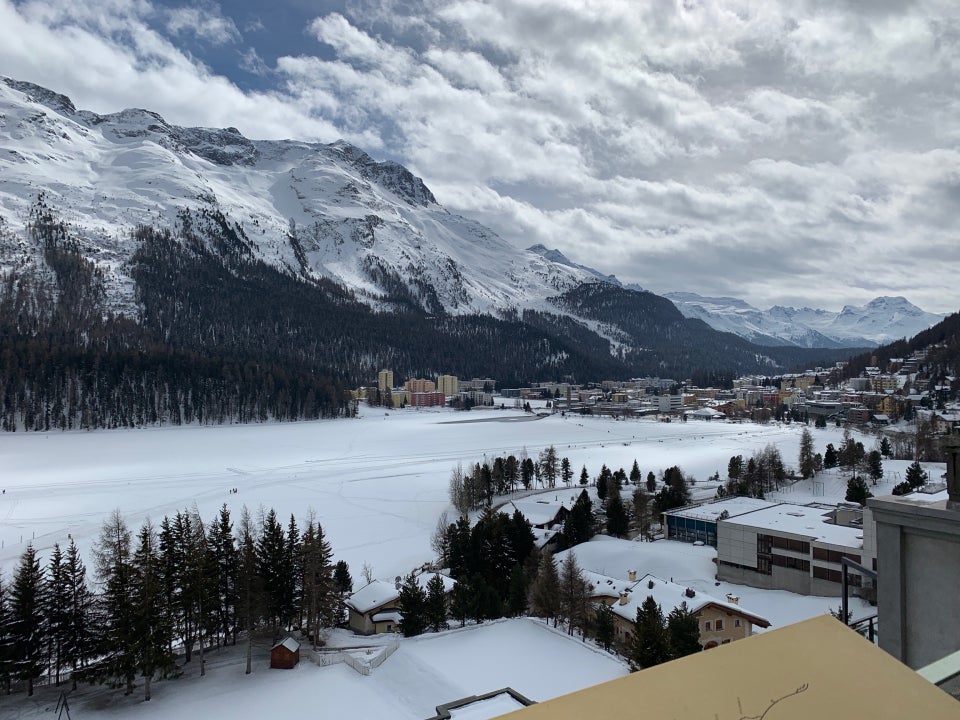
Start at Lake St. Moritz (St. Moritzersee). The lake sits at 1,822 metres in the centre of the valley, and a promenade loops along its western and northern shores — a flat, easy walk of about 45 minutes that gives you the full panorama of the Engadin: the Bernina massif to the south, the Corvatsch glacier to the east, and the Muottas Muragl ridge to the northwest. In summer the lake is a deep alpine blue-green; in autumn the surrounding larch forests turn copper-gold; in winter it freezes solid enough to host polo matches and horse racing on ice — the famous White Turf event that has been running since 1907.
Walk the promenade south toward St. Moritz Bad, the quieter village at the lake's lower end. The path passes the old spa buildings and the PCI — the Pension Civil, a grand hotel from the early 20th century that now houses part of the town's cultural programme. From the shore you can see the Badrutt's Palace Hotel on the hillside above — the turreted silhouette that has defined St. Moritz's skyline since 1896. You do not need to go inside unless you want to pay 45 francs for afternoon tea, but the exterior is worth studying: a château-style fantasy built at the height of Belle Époque confidence, when St. Moritz was competing with Nice and Cannes for the European elite.
From the lake, walk uphill through the village to the Segantini Museum (Segantini Museum St. Moritz), a five-minute climb from the lake promenade. The museum was built in 1908 to house the work of Giovanni Segantini, an Italian-Swiss painter who spent his final years in the Engadin and died at nearby Schafberg (2,582m) in 1899. His masterpiece, Life, Death and the Hereafter — a monumental triptych originally conceived for the 1898 Paris World Exposition — occupies three specially designed rooms, each canvas filling an entire wall. The three panels form a single panoramic vision of the Engadin landscape as a stage for spiritual drama: alpine pastures in summer light on the left, the dark ridge of death in the centre, and a luminous afterlife dissolving into the mountains on the right. Few paintings are given their own dedicated gallery architecture; fewer still justify it. This one does. Entry costs 8 francs and takes about 45 minutes.
From the Segantini Museum, walk five minutes to the Chantarella funicular station in St. Moritz Dorf. The funicular climbs 750 metres from 1,822m to the Corviglia ski area at 2,484m in under seven minutes, and the first section from Chantarella to Corviglia passes through open alpine meadows with a view that takes in the entire Engadin valley — a ten-kilometre panorama from Silvaplana in the west to Celerina in the east. In summer the meadows are wildflower-rich; in winter they are buried under two metres of snow and the funicular feeds one of the largest linked ski domains in Switzerland.
At Corviglia, get off and walk the panoramic terrace behind the mountain station. The view south toward the Piz Bernina (4,049m) — the highest peak in the Eastern Alps — is one of the great mountain panoramas in Switzerland. The Bernina group's glaciers are visible without any further effort; you are already at 2,484 metres and the peaks are just 1,600 metres above you. On a clear day, the view extends to the Dolomites 150 kilometres to the southeast.
For lunch, head to the Corviglia restaurant complex at the mountain station. In summer the terrace is open for grilled meats, rösti, and Engadin-style barley soup — simple alpine food at moderate altitude-inflated prices (a main course runs 28–38 francs). If you want something more refined, take the second section of the funicular up to Piz Nair at 3,057 metres, where the restaurant serves a full menu with views that have not changed since the first funicular opened in 1913. The dining room is one of the highest-altitude restaurants in the Engadin.
Take the funicular back down and spend the afternoon exploring the two parts of St. Moritz that tourists often miss: St. Moritz Dorf and St. Moritz Bad.
St. Moritz Dorf is the main village — the one with the lake promenade, the Badrutt's Palace, the Kulm Hotel, and the luxury shops along Via Serlas. The Via Serlas is worth a walk even if you buy nothing: Swarovski crystals, haute couture boutiques, and a Louis Vuitton in a building that was once a 19th-century spa pavilion. The street runs from the lake uphill toward the Matterhorn Glacier Paradise cable car base, and the people-watching is world-class.
St. Moritz Bad, five minutes south by bus or 15 minutes on foot, is the old spa village at the lake's southern end. It is quieter, cheaper, and in many ways more charming than the Dorf. The streets are wider, the buildings are lower, and the pace of life is the slow rhythm of a mountain village that existed long before luxury tourism arrived. The Haldenhof building and the old bathhouse are worth a look for the architecture alone.
From St. Moritz Bad, walk east along the lake shore to find Alvaieral, a small alpine lake just 15 minutes from the village centre. Alvaieral is a calm, reed-fringed body of water with reflections of the surrounding mountains that photographers prize but most visitors never find. It sits in a boggy meadow at the lake's eastern tip, and a boardwalk path circles it in about 20 minutes. Bring binoculars — the lake attracts migratory waterfowl in spring and autumn.
If you have a second day or simply want a grand finale, take the Muottas Muragl funicular from the valley floor near Silvaplana. It climbs to 2,456 metres in ten minutes and delivers what many consider the definitive Engadin view — the entire chain of alpine lakes from Silvaplana through Sils to Lake St. Moritz, laid out below you like a map. The terraced restaurant at the top serves dinner with a view that has made this the most popular sunset spot in the region. This is a separate excursion from St. Moritz Dorf, requiring a bus to Silvaplana first, so only attempt it if your train connection gives you five or more hours.
St. Moritz is expensive, but not uniformly so. The luxury hotel restaurants — Nadja's Kitchen in Badrutt's Palace, the Grand Restaurant at the Kulm — are excellent but priced for visitors who are not checking train timetables. For a day-tripper looking for good food at more reasonable prices, three restaurants stand out:
Chesa Veglia — housed in a 16th-century Engadin farmhouse in the Dorf, Chesa Veglia serves traditional Engadin cuisine in a setting of vaulted stone cellars and timber beams. The pizzoccheri (buckwheat pasta with cabbage, potatoes, and Valtellina cheese) and the local Engadin trout are reliably good. This is the kind of place where you sit in a room that has been serving food for five hundred years. Reservations recommended.
Hotel & Restaurant Albana in St. Moritz Bad — a family-run restaurant with a terrace overlooking the lake, serving seasonal Engadin dishes at prices that will not cause a cardiac event. The rösti with local cheese is generous and the wine list favours Swiss producers. In summer the terrace is one of the most pleasant places to eat in the Engadin.
Bistro Bar Gườnt — the local's favourite for casual eating. A small wine bar near the lake that serves charcuterie boards with Engadin meats and cheeses, seasonal tartes, and Swiss wines by the glass. It fills up after 18:00 when the day-trippers have gone and the locals arrive. No reservations; arrive early or be patient.
For coffee and cake, the Café Hanselmann in the Dorf has been serving Engadin tortes and Nusstorte (the famous Engadin walnut tart) since 1897. The interior has not changed significantly since then. A slice of Nusstorte and an espresso will cost about 10 francs and give you a seat in one of the most atmospheric cafés in the Alps.