Skiing, snowshoeing, the Cresta Run, Lake St. Moritz frozen over, and the White Turf horse race on ice — a complete guide to winter in the Engadin.
In 1864, a St. Moritz hotelier named Johannes Badrutt made a wager with his English summer guests. He bet them that winter in the Engadin — sunshine, crisp air, and deep snow at 1,822 metres — was more enjoyable than a damp English November. If they did not love it, he would cover their travel costs. They came back. They loved it. And St. Moritz became the birthplace of winter tourism.
That origin story matters because St. Moritz in winter is still, fundamentally, about the quality of light and air. The Engadin valley sits on a high plateau surrounded by 4,000-metre peaks, and the combination of altitude and dry continental climate produces a winter that is brighter, colder, and drier than almost anywhere else in the Alps. The sun shines an average of 322 days a year here. In February, when the days are short elsewhere, St. Moritz is still bathed in light from mid-morning to late afternoon, the snow glittering on the valley floor while cloud sits in the lowlands far below.
This guide covers everything worth doing in St. Moritz between December and March — the skiing, the frozen lake, the Cresta Run, snowshoeing, Christmas markets, and how to get there by train when the mountain passes are at their most spectacular.
St. Moritz gives access to three distinct ski areas, all covered by the Engadin Skiiervalue lift pass. Together they offer over 350 kilometres of groomed runs, but the character of each area is different enough to warrant exploring all three.
Corviglia is the closest and most popular — a 10-minute ride on theIGNALA cable car from the centre of town. It sits at 2,488 metres and offers wide, sun-drenched cruising above the treeline with views of the Bernina massif and Piz Nair. The black run from Piz Nair down to Corviglia is the showpiece — 4.8 kilometres of sustained steep terrain with a 1,500-metre vertical drop, one of the longest continuous ski runs in the Alps. For intermediates, the blue and red runs from Margun and Chantarella are wide, well-groomed, and never intimidating. Corviglia is where you spend most of your days.
Corvatsch sits on the opposite side of the valley, reached by a gondola from Sils. It is higher (3,303 metres at the summit), wilder, and quieter than Corviglia. The north-facing slopes hold good snow late into the season, and the long red run down to Surlej — nearly 10 kilometres — is the kind of descent you remember for years. Corvatsch also has a terrain park for freestylers and hosts night skiing sessions on Wednesdays and Fridays until 22:30, the floodlit slopes eerie against the dark valley walls.
Diavolezza is the most dramatic of the three. A cable car from the Bernina road climbs to 2,754 metres, depositing you at a glacier restaurant with a direct view of the Morteratsch Glacier and the Piz Palü face. The skiing here is intermediate to advanced — long reds and blacks sweeping down glacier terrain with genuinely alpine scenery. Diavolezza is also the starting point for glacier ski touring if you hire a guide. It is worth at least one day, even if you prefer Corviglia for daily skiing.
A combined Engadin lift pass costs approximately CHF 82 per day for adults in the 2025/26 season, with multi-day passes offering better value — five days from around CHF 380. Children under 12 ski free with a Junior Card. Ski equipment rental is available throughout St. Moritz village, with prices around CHF 50–70 per day for a full set.
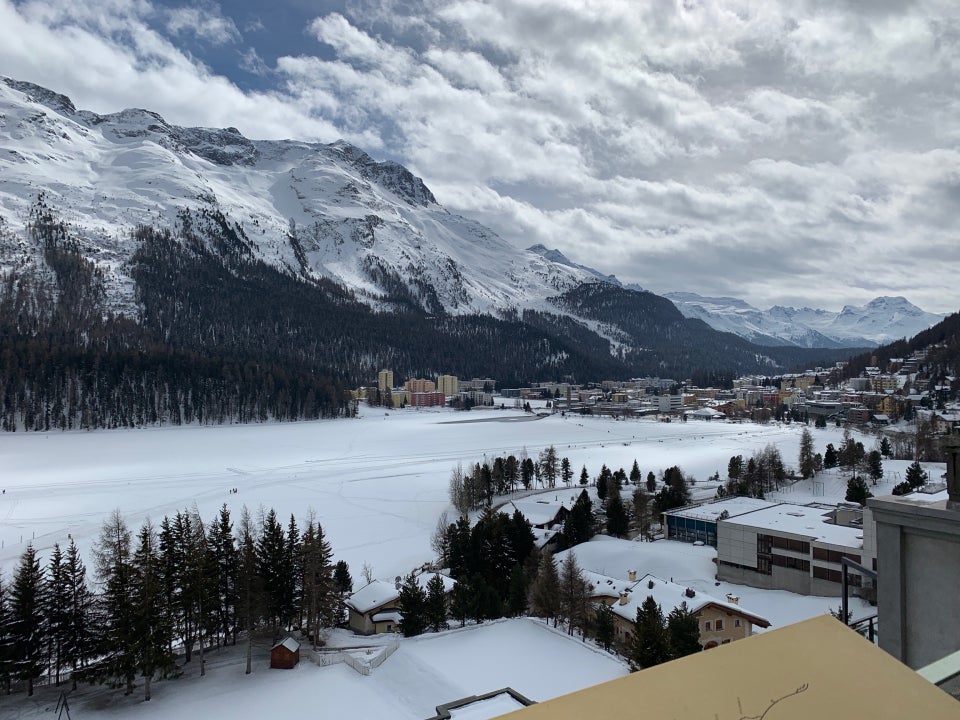
Lake St. Moritz is a 5.6-kilometre glacial lake that sits in the centre of the valley at 1,768 metres. In a normal winter, the surface freezes solid by late December and remains frozen through March — a vast white plain surrounded by mountains that becomes one of the most unusual event venues in Europe.
Walking on the frozen lake is itself a memorable experience. A marked path is maintained across the ice from the village toward Silvaplana, and the silence of standing on a frozen body of water — hearing nothing but your own footsteps and the distant clatter of ski lifts — is a particular kind of winter peace. Be cautious near inlets and the lake outlet, where the ice is thinner; stick to the marked path.
But the frozen lake is best known for what happens on it. The White Turf horse races, held annually on the second Sunday of February, see thoroughbred horses galloping across the ice with the Engadin mountains as a backdrop. The event dates back to 1907 and attracts tens of thousands of spectators. There is also polo on snow — international matches played on the ice throughout February — and skijöring, where skiers are pulled by horses at high speed along the frozen shore. The atmosphere is festive, champagne-fuelled, and distinctly St. Moritz.
If you visit in February, check the event calendar. White Turf in particular sells hospitality packages well in advance; general admission is more affordable and still gives you a grandstand view of horses racing on ice, which is a sight you will not see anywhere else.
The Cresta Run is the most famous natural skeleton track in the world — a 1,220-metre ice chute carved by hand each winter between St. Moritz and the village of Celerina. It has been ridden since 1887, and the St. Moritz Tobogganing Club maintains it through the season with volunteers chipping ice and rebuilding corners after every thaw.
The run has 10 named corners, each with its own character and legend. The most famous is Marble Arch, a blind left-hand bend at the steepest point where riders hit the highest speeds — upwards of 130 km/h — and the track passes beneath a natural ice arch. After Marble Arch, the run straightens into the long, fast stretch down to the finish, where riders who have maintained their nerve are rewarded with a time that may enter the club's historic ranking lists.
You do not need to ride the Cresta to appreciate it. Spectating is free — simply walk to the track and watch from the banks. The best vantage points are at Marble Arch and the start ramp, where you can see riders launch themselves head-first onto the ice with an abandon that borders on the irrational. Races take place throughout January and February, and the St. Moritz Tobogganing Club publishes a schedule on its website.
For those who want to try it, the club offers introductory sessions, but it is not a casual activity — you need a full skeleton suit, a helmet, and ideally some prior experience on ice tracks. The learning curve is vertical and the consequences of getting it wrong are real. Watching is, for most visitors, the right call.
Beyond the ski areas, the Engadin has an extensive network of winter hiking trails — marked paths across the valley floor and through forests that are groomed for walking (not snowshoeing) when conditions allow. The trails are flat to gently undulating, waymarked with yellow signs, and accessible directly from the village.
For something more immersive, the Engadin Winter Trails network includes over 200 kilometres of snowshoe routes ranging from gentle valley walks to serious mountain traverses. The Muottas Muragl snowshoe route is the one to prioritise if you have one day. You take the Muottas Muragl funicular from the valley floor to 2,453 metres, and from there a marked snowshoe trail descends through alpine forest back to Pontresina — roughly three hours, with views over the Upper Engadin lakes that are among the finest in the region. Snowshoe rental is available at outdoor shops in St. Moritz for around CHF 25 per day.
The Engadin Valley Trail — a flat, groomed path running along the Inn river from St. Moritz to S-chanf — is another option for a half-day outing, suitable for families and anyone who prefers walking without gaining altitude. The trail passes through quiet larch forest, the trees heavy with snow in mid-winter, and the silence is absolute.
St. Moritz is not a Christmas market town in the German or Austrian tradition, but it holds its own version in the weeks leading up to the holidays. The St. Moritz Village Market runs on the lakefront in mid-December — wooden chalets selling Swiss crafts, Engadin honey, local cheese, Glühwein, and hand-carved decorations. The setting is more elegant than rustic: fairy lights strung between the grand hotels, snow on the rooftops, the frozen lake behind the stalls.
The Engadin Christmas events extend across the valley. Pontresina, Sils, and Silvaplana each hold smaller markets on different weekends, and the whole region takes on a festive atmosphere in the week before Christmas, with church concerts, torchlight processions down the ski slopes, and traditional Chalandamarz celebrations on 1 March marking the end of winter. If your visit overlaps with the Christmas period, check the Engadin event calendar for specific dates — the markets rotate across villages and change schedule from year to year.
The Engadin Light festival, usually held in early December, is worth timing your visit around — an installation of light art across the valley, with projections on the lake, buildings, and mountain faces creating an otherworldly atmosphere in the early winter darkness.
St. Moritz is reachable by train year-round, but the journey in winter is arguably the most scenic of any season. The Bernina Express from Chur or Tirano passes through winter landscapes that are almost too dramatic to believe — snow-buried forests, frozen viaducts, and the Bernina glacier amphitheatre under a clear winter sky. The light in winter is different from summer: lower, golden, and long-lasting through the morning and afternoon. If you are coming from the south (Tirano in Italy), the Bernina line climbs from olive trees to glaciers in two hours.
From Zurich or Lucerne, the standard route is via the Glacier Express corridor to Chur, then onward on the Rhaetian Railway through the Engadin. The Glacier Express operates a winter timetable from mid-December to mid-April, with the Zermatt–Chur section running daily. The journey from Zurich to St. Moritz takes about five hours with one change; from Lucerne, roughly four and a half hours via the Gotthard route.
The Bernina Express bus service from Lugano to St. Moritz via the Maloja Pass operates in winter, but only when road conditions permit — check schedules carefully, as the pass can close temporarily in heavy snow. The train route from Lugano via Tirano is the more reliable winter option for reaching St. Moritz from the south.
Ski lessons, guided off-piste sessions, and snowshoe tours in the Engadin — curated experiences with local guides via GetYourGuide.
Browse Ski Experiences →