Same track, same views, different price. Which one deserves your money?
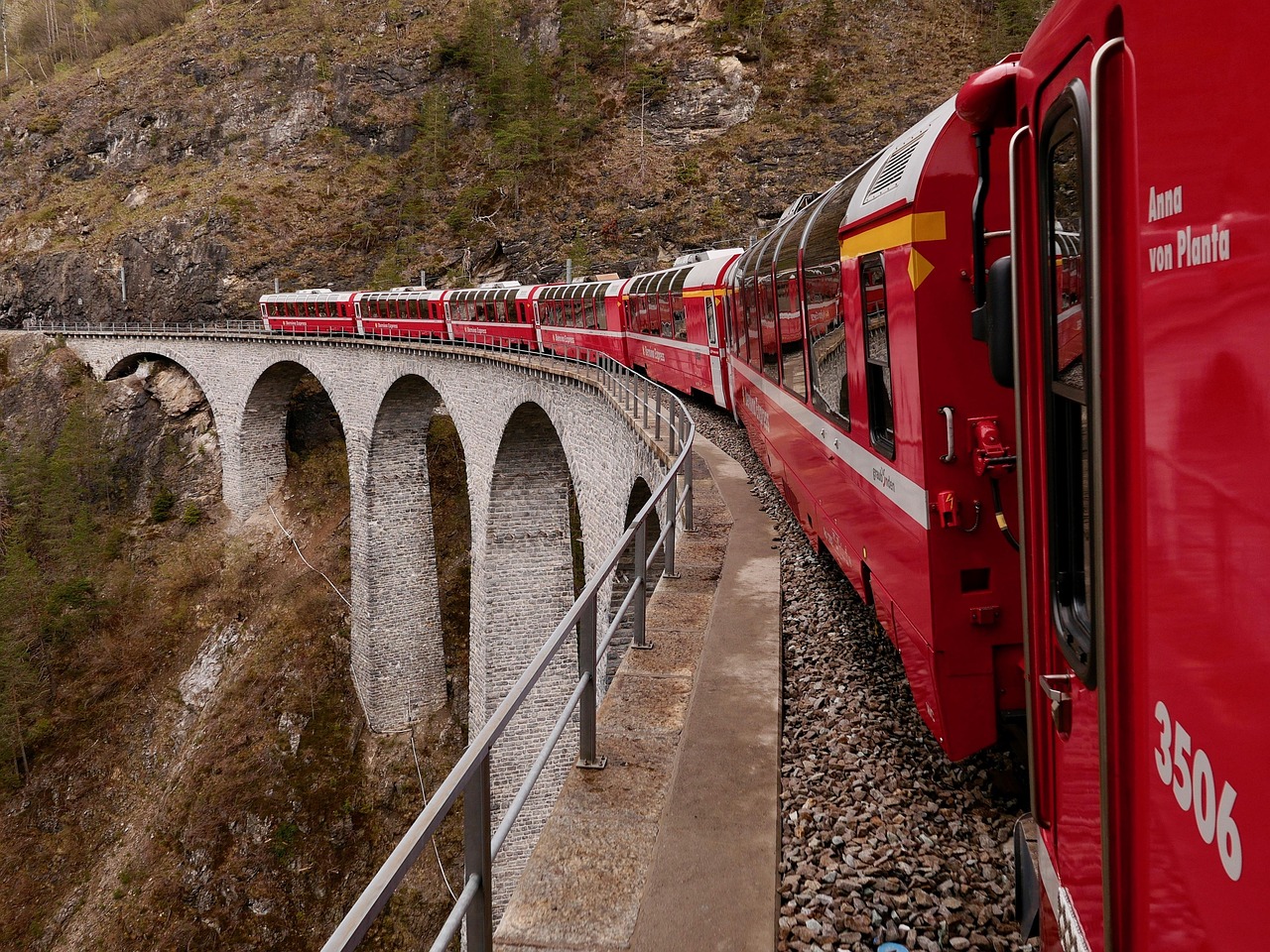
Here is the fact that changes everything about planning the Bernina Express: the famous red panoramic train and the regular Rhaetian Railway regional train run on the exact same track. Every curve, every viaduct, every glacier view — identical. The Brusio spiral, the Lago Bianco shoreline, the Ospizio Bernina at 2,253 metres — both trains stop at the same stations and follow the same rails across the Bernina Pass. The difference is not the route. The difference is the carriage you sit in.
This matters because the Bernina Express panoramic ticket costs significantly more than a standard regional train fare, and many travellers assume the extra money buys a better route. It does not. What it buys is a reserved seat in a glass-roofed carriage with an audio guide, a slightly smoother ride, and a guarantee that you will not be standing in the corridor with thirty other people who all had the same idea. Whether that is worth the premium depends entirely on who you are and what kind of traveller you want to be on this particular day.
The Bernina Express panoramic carriages are purpose-built for the route. The windows extend into the roof, giving you a wide upward field of view that is especially valuable on the approach to the Bernina Pass, where the mountains close in on both sides and the sky dominates. The seats are reserved — you pick a seat number when you book, and that is where you sit for the entire journey. Each seat has a small screen that plays an audio guide in multiple languages (German, Italian, French, English, and others), narrating the history, geography, and engineering of the line as you pass each landmark.
The carriages are climate-controlled, clean, and quiet. Luggage racks above the seats hold standard-sized bags; larger luggage goes in the storage area at the end of the car. There is a small bistro area on some services, though it is more of a vending situation than a proper restaurant car. The ride quality is smooth — the Rhaetian Railway maintains its fleet to a high standard — but the panoramic cars are heavier and more stable than the standard regional rolling stock.
In practical terms, the panoramic train guarantees three things: a window seat, a narration of what you are seeing, and a seat for the entire journey. That is the value proposition. It is a polished, curated experience of a spectacular railway line.
The regional Rhaetian Railway trains — sometimes called the Bernina Express regionally but without the panoramic branding — use standard carriages on the same track. The windows are normal-sized, the seats are not reserved, and there is no audio guide. The journey takes the same amount of time, makes the same stops, and passes through every single point of interest along the route.
The regional train has several advantages that are easy to overlook. First, you do not need to book in advance. During peak summer, the panoramic train can sell out days ahead; the regional train rarely fills to the point where you cannot find a seat, especially if you board at Chur, Pontresina, or Tirano rather than at St. Moritz. Second, you can get on and off. If you want to stop at Alp Grüm for an hour, have lunch at the Chalet Berghaus, and catch the next regional train onward to Tirano, you can do that. The panoramic train does not permit intermediate stops — your reserved seat is for the complete journey only.
Third, and this matters more than you might think: you can open the windows. On a regional train, you can crack open the window for unobstructed photographs. On the panoramic train, you are shooting through thick safety glass that produces reflections, especially in bright sunlight. Photographers who care about image quality almost universally prefer the regional train for this reason alone.
As of 2026, the numbers look roughly like this. A second-class seat on the regional train from Chur to Tirano costs around CHF 75 one way (or is fully covered by a Swiss Travel Pass with no reservation fee). The same journey on the Bernina Express panoramic train costs around CHF 60–66 for the base fare plus a mandatory reservation fee of CHF 16–20, bringing the total to roughly CHF 76–86 one way depending on the season and class.
From St. Moritz, the regional train fare is lower — approximately CHF 32 one way — because the distance is shorter. The Bernina Express from St. Moritz to Tirano runs about CHF 36 base fare plus the CHF 16–20 reservation fee, totalling CHF 52–56. For the return journey, you pay the same again in each direction.
Here is the critical detail for pass holders: the Swiss Travel Pass covers the full regional train fare at no additional cost. No reservation fee, no supplement. You show your pass, you board, you sit down. The Bernina Express panoramic train, by contrast, requires a separate reservation fee even with a Swiss Travel Pass — typically CHF 16 in second class and CHF 20 in first class per direction. For a return trip, that is an extra CHF 32–40 on top of a pass you have already paid for.
Over four seasons of travellers asking us the same question, the answer is consistent: if you have a Swiss Travel Pass, the regional train is the better financial decision in almost every scenario.
Solo travellers and couples on a budget. If you are watching your spending — and Switzerland makes that necessary — the regional train saves you CHF 30–40 per person on a return trip compared to the panoramic, with no meaningful sacrifice in what you see. The savings are enough for a very good lunch in St. Moritz or a round of drinks in Tirano.
Photographers. This is the strongest case for the regional train. The ability to open a window and shoot without glass reflections is the difference between a usable photograph and a frustrated delete. The best light is in the early morning and late afternoon; the regional trains at those times are usually quiet enough that you can move between carriages to follow the light.
Travellers who want to stop along the way. The Bernina Pass has several remarkable intermediate stops that the panoramic train passes through without allowing you to disembark. Alp Grüm, at 2,097 metres, has a terrace restaurant with a direct view of the Palü Glacier and the Val Poschiavo below — one of the most dramatic lunch spots in the Alps. Morteratsch is the trailhead for hikes to the Morteratsch Glacier tongue. Poschiavo is a charming Italian-speaking village with a lakeside promenade and the famous Le Prese. On a regional train, you can stop at any of these, spend an hour or two, and catch the next service onward. This transforms the Bernina crossing from a sit-and-watch experience into a full-day exploration.
Experienced travellers and repeat visitors. If you have been to Switzerland before, or if you are comfortable navigating trains independently, the regional train gives you more control over the experience without the hand-holding of an audio guide. You can listen to your own music, read a book, or simply sit with the window down and let the landscape do the talking.
Families with young children. The reserved seating eliminates the stress of finding seats together, the audio guide keeps children occupied during the longer stretches, and the panoramic windows make it easy for small people to see over the window ledge. The extra cost buys a smoother, more predictable experience — which, with children, has real value.
First-time visitors who want the "full experience." The Bernina Express is one of those journeys that people plan a trip around, and the panoramic train is the iconic version of it. If this is your once-in-a-lifetime visit and you want the red train, the glass roof, and the narrated story — book it. The premium is not enormous in the context of an overall Swiss trip, and the curated experience is genuinely enjoyable.
People travelling in peak season with fixed schedules. In July and August, when regional trains can get crowded and you cannot guarantee everyone in your group gets seats together, the panoramic train's reservation system solves the problem. You know exactly where you are sitting, you are together, and you are comfortable. For families or groups with limited travel days, this predictability matters.
Travellers with limited mobility. The panoramic carriages are designed with level boarding and wider aisles. If mobility is a concern, the guaranteed seat and the more spacious layout make the panoramic train the more accessible option, though the Rhaetian Railway does accommodate wheelchairs on regional services with advance notice.
Return day-ticket with reserved panoramic seat — Chur or St. Moritz to Tirano and back. Instant confirmation via GetYourGuide.
Book Panoramic Return Ticket →The Bernina Express panoramic train is a good product. It is comfortable, well-organised, and the glass roof genuinely enhances the experience at altitude. If you want the polished version of this journey, book it without hesitation.
But the regional train is not the inferior option — it is the different option. It is the choice that lets you travel like a local on a local railway, stop where you want, photograph without barriers, and save money doing it. For many travellers, especially those with a Swiss Travel Pass, it is the smarter call.
The track does not care which train you are on. The mountains do not look different through a panoramic window. The Bernina Pass was spectacular before the Bernina Express existed, and it will be spectacular long after. Your job is to choose the train that fits your travel style — not the one with the best marketing.
Both trains cross the same 122 kilometres of the most beautiful railway line in the Alps. You cannot make a wrong choice here.