Four rail approaches to the Engadin. Each one is a different kind of Swiss railway experience.
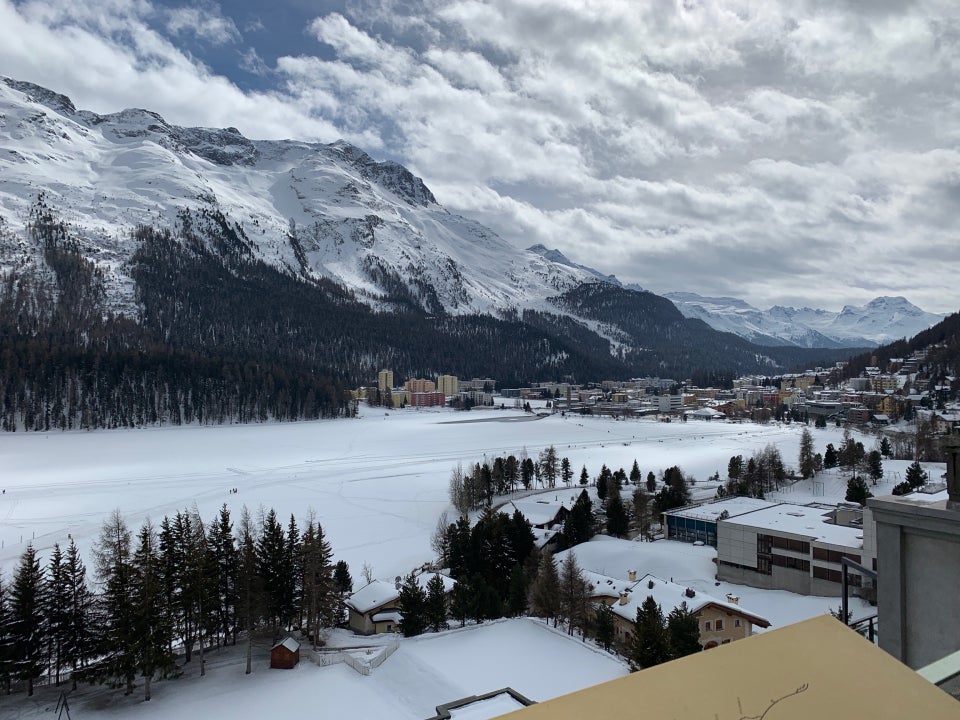
St. Moritz sits at 1,822 metres in the Upper Engadin, a high alpine valley of frozen lakes, larch forests, and villages that look like they were placed there by someone with a very good eye. It is the terminus of two of Switzerland's most famous railway experiences — the Bernina Express from Tirano and the Glacier Express from Zermatt — as well as a regular stop on the Rhaetian Railway's internal network. Getting there is not a problem. The question is which way you want to arrive, because every approach is a different journey.
This guide covers the four practical rail routes into St. Moritz: from Zurich, Milan, Chur, and Tirano. Each has a different character, different cost profile, and different scenery. The right choice depends on where you are coming from, how much time you have, and how much of the journey you want to enjoy as a journey in itself.
The most straightforward way to reach St. Moritz from Zurich is the direct InterCity (IC) train operated by SBB. It runs from Zurich Hauptbahnhof to Chur, where you change onto a Rhaetian Railway (RhB) service that continues over the Albula line and through the Engadin to St. Moritz. The entire journey takes approximately 3 hours and 30 minutes, including the connection in Chur.
The Zurich–Chur leg follows the mainline through the Graubünden foothills — fast, efficient, and not particularly scenic until the final approach to Chur, where the Rhine valley opens up. But the moment you step across the platform at Chur and board the red RhB train heading south, the character of the trip changes entirely. The Albula line is one of the most celebrated mountain railways in Europe. Within minutes of departing Chur, the train enters the Schyniger Platte section, where tight curves and spiral tunnels carry the line up through forested gorges. The panorama carriages of the Bernina Express are sold out months in advance, but the regular regional RhB trains run on the same tracks, use the same route, and cost a fraction of the price. You do not need a panoramic carriage to appreciate the Albula line — a window seat on any train will do.
Stops between Chur and St. Moritz include Tiefencastel, where the train enters the dramatic Albula gorge; Humans, with views of the convention-defying Landwasser Viaduct visible from certain carriages; and Samedan, the last stop before St. Moritz where the valley widens and the Engadin's distinctive light and architecture come into view. The final stretch follows the Inn river upstream, passing through Pontresina and Celerina before arriving at St. Moritz station.
Cost: A one-way second-class ticket from Zurich to St. Moritz costs approximately CHF 75–90 depending on the fare class and how far in advance you book. First class is CHF 130–150. Saver fares (discounted tickets with limited flexibility) can reduce the cost by 30–40% if booked at least two weeks ahead through the SBB website or app. The Swiss Travel Pass covers the entire route with no supplement on regional trains, making it the most cost-effective option if you are travelling on multiple Swiss railways during your trip.
Travellers coming from northern Italy have two main options, and they could not be more different.
Option 1: Milan to Tirano, then the Bernina Express north to St. Moritz. This is the longer route in terms of travel time — approximately 4 hours door to door — but it is also one of the most spectacular rail journeys in Europe. From Milano Centrale, regular Trenord trains run east through the Lombardy plain and up the Valtellina to Tirano, a journey of about 2.5 hours. From Tirano, you board the Bernina Express (or a regional RhB train) and climb south through the Bernina Pass to St. Moritz. The ascent takes about 1.5 hours.
What makes this approach remarkable is the altitude change: Tirano sits at 429 metres with palm trees and Mediterranean light; St. Moritz sits at 1,822 metres above a frozen lake. In a single train ride you pass from Italy into Switzerland, from wine country into the high Alps, from a world of espresso bars into one of mountain churches and snow-dusted larch forests. The Bernina crossing passes the Morteratsch glacier, the Bernina Pass at 2,253 metres (the highest point of any standard-gauge railway in the Alps), and the Alp Grum viewpoint before descending to St. Moritz.
Option 2: Milan to Zurich via the Gotthard route, then Zurich to St. Moritz. This is faster if your final destination is Zurich as well — the Gotthard Base Tunnel cuts the Milan–Zurich time to about 3.5 hours — but it adds the Zurich–St. Moritz leg on top, bringing the total to around 6 hours. The Gotthard route itself is mostly underground (the base tunnel is 57 kilometres long), so while it is efficient, it is not scenic. Unless you have specific reasons to route through Zurich, the Tirano approach is almost always the better choice for the Milan–St. Moritz journey.
Cost from Milan: A Milan–Tirano train costs roughly €15–25 one way depending on the fare. The Tirano–St. Moritz segment is covered by the Swiss Travel Pass; otherwise a single ticket costs approximately CHF 32. The Bernina Express panorama carriage requires a seat reservation on top of the base ticket — CHF 14 in second class, CHF 20 in first. A return day-ticket from Tirano bundles the Bernina Express seat reservation with a standard ticket at a slight discount.
Chur is the capital of Graubünden and the gateway to the Rhaetian Railway network. If you are already in Chur — arriving by car, by bus, or on the Zurich IC — the connection to St. Moritz is direct and regular. RhB trains run approximately once per hour from Chur to St. Moritz via the Albula line, with the journey taking about 2 hours and 30 minutes.
This is, for our money, the most underrated approach to St. Moritz. The Albula line between Chur and St. Moritz was inscribed as a UNESCO World Heritage Site in 2008, alongside the Bernina line, and for good reason. The route includes 144 tunnels, 48 bridges, and several spiral tunnels that gain altitude so gradually that you barely notice the climb until you look out the window and realise you are looking down on the valleys below.
The most photogenic sections are the crossing of the Landwasser Viaduct — a 65-metre-high curved limestone bridge that leads directly into a tunnel carved into the cliff face — and the descent into the Albula gorge below Tiefencastel. If you are sitting on the right-hand side of the train heading south, you will have the best views of the viaduct. Sit on the left for the gorge.
From Chur you can also take the Arosa–Chur railway as a side trip. This branch line climbs to the ski resort of Arosa in about an hour, passing through the Weisshorn valley. It is a separate fare from the St. Moritz service and not covered by the same ticket, but it is a beautiful half-day excursion if you have time before or after your Engadin trip.
Cost: A one-way second-class ticket from Chur to St. Moritz costs approximately CHF 40–55 on regional trains. The Swiss Travel Pass covers the full route with no supplement. Reservations are not required on regional RhB services, so you can board any train and choose your seat on the day.
Most visitors to the Bernina Express travel from St. Moritz south to Tirano — it is the standard direction promoted by tour operators, and it means finishing in Italy for lunch. But doing it the other way — starting in Tirano and climbing north to St. Moritz — is an equally spectacular and significantly less crowded experience.
The Bernina line ascends 1,823 metres over 56 kilometres, from Tirano's 429 metres to the Bernina Pass at 2,253 metres. The most dramatic scenery — the Ospizio Bernina, Lago Bianco, the Morteratsch glacier — is concentrated on the upper half of the route, and seeing it from the south means you approach the scenery rather than leave it behind. The first views of the glacier open up ahead of you rather than receding behind, and the sense of arrival in St. Moritz feels more earned.
From Tirano, the Bernina Express runs once or twice daily in each direction (depending on the season), and the journey takes about 1 hour and 45 minutes. Regional RhB trains cover the same route more frequently and without requiring a seat reservation, though they lack the commentary and the panoramic windows. Practically speaking, the regional trains are often the better choice: they are cheaper, more frequent, and the standard carriage windows on the RhB fleet are large enough to take in the scenery comfortably.
If you are starting from Milan, the Tirano–St. Moritz leg connects with Trenord services from Milano Centrale, making the full Italy-to-Engadin journey a seamless two-seat ride. Our guide to spending a day in Tirano covers what to do if you have a few hours between the Trenord arrival and the Bernina departure.
Cost: Same as the Milan route for the Swiss segment — CHF 32 one way without a pass, free with a Swiss Travel Pass. The Bernina Express supplement is CHF 14/20 for second/first class.
The right route depends on your starting point and priorities. Here is a quick comparison:
| Route | Duration | Cost (2nd class) | Scenery | Best For |
|---|---|---|---|---|
| Zurich → St. Moritz | 3.5 hrs | CHF 75–90 | Moderate (Albula line from Chur) | Fastest from Zurich airport, easy connection |
| Milan → Tirano → St. Moritz | ~4 hrs | €15–25 + CHF 32 | Extraordinary (Bernina crossing) | Italy–Switzerland crossing, most scenic |
| Chur → St. Moritz | 2.5 hrs | CHF 40–55 | High (Albula UNESCO route) | Already in Graubünden, simplest journey |
| Tirano → St. Moritz | 1 hr 45 min | CHF 32 | Extraordinary (Bernina ascent) | Shortest scenic leg, undervisited direction |
Seasonal considerations: The Bernina and Albula lines operate year-round, but the experience differs dramatically between seasons. In winter (December–March), the Engadin is buried in snow and the railway becomes a white corridor punctuated by dark tunnel mouths. The Bernina Pass section can be genuinely Arctic — Lago Bianco freezes solid, and the contrast with Tirano's palm-lined streets is even more extreme. Summer (June–September) brings wildflowers to the high meadows and green light through the larch forests, but also peak crowds on the Bernina Express. The shoulder seasons — May and October — offer the best balance of scenery, solitude, and reliable weather. Autumn in the Engadin, when the larch forests turn gold against the grey granite peaks, is one of the most beautiful things you will see from any train in Europe.
Swiss Travel Pass: The Swiss Travel Pass covers all Rhaetian Railway and SBB trains in Switzerland, including the entire Albula and Bernina lines. It also covers the PostBus connections in Graubünden and lake boats on Lake St. Moritz. If you plan to ride more than two scenic railways during your Swiss trip, the pass almost certainly pays for itself. A consecutive 4-day pass costs CHF 244 in second class; an 8-day pass costs CHF 395. Children under 16 travel free with a Swiss Family Card when accompanying a parent with a valid pass.
Seat reservations: Regional RhB trains do not require reservations — you sit where you like. The Bernina Express and Glacier Express panorama services require a mandatory seat reservation (CHF 14–20 depending on class) on top of your base ticket. In peak summer, reserve at least two weeks in advance. In shoulder season, a few days is usually enough.
Luggage: There are no luggage limits on Swiss trains. You can bring oversized bags, ski equipment, and bicycles (with a bike ticket). Luggage racks are available at the ends of each carriage. On the Bernina Express, larger luggage goes in the dedicated racks near the panoramic cars; on regional trains, the overhead racks and floor space at carriage ends are sufficient for standard suitcases.
Weather in the Engadin: St. Moritz is at 1,822 metres and the weather is alpine. Summer days are warm (18–25°C) but mornings and evenings can be cool, especially in September. Winter temperatures regularly drop below -10°C. Snow is possible in any month. The valley is known for its sunshine — the Engadin receives more hours of sun per year than almost anywhere else in Switzerland — but conditions can change rapidly at altitude. Bring layers regardless of the season.
Booking: For SBB and RhB tickets, the SBB Mobile app is the most convenient way to buy and store tickets. It works on all Swiss trains and shows live departure boards, platform numbers, and delay information. For the Bernina Express panorama service specifically, you can book through the Rhaetian Railway website or through operators like GetYourGuide, which often bundles the seat reservation with a guided commentary or a combined ticket.
Connections from St. Moritz: Once you arrive, St. Moritz is a useful base for the wider Engadin. The Glacier Express departs daily to Zermatt (4 hours); regular RhB trains connect to Davos (2 hours) and Chur (2.5 hours); PostBus services run to the Italian border and across the Maloja Pass to Lugano. The St. Moritz destination guide covers what to do in the valley itself.
Day-tickets and guided journeys on the Bernina Express and Glacier Express, departing from St. Moritz. Instant confirmation via GetYourGuide.
Browse St. Moritz Tours →