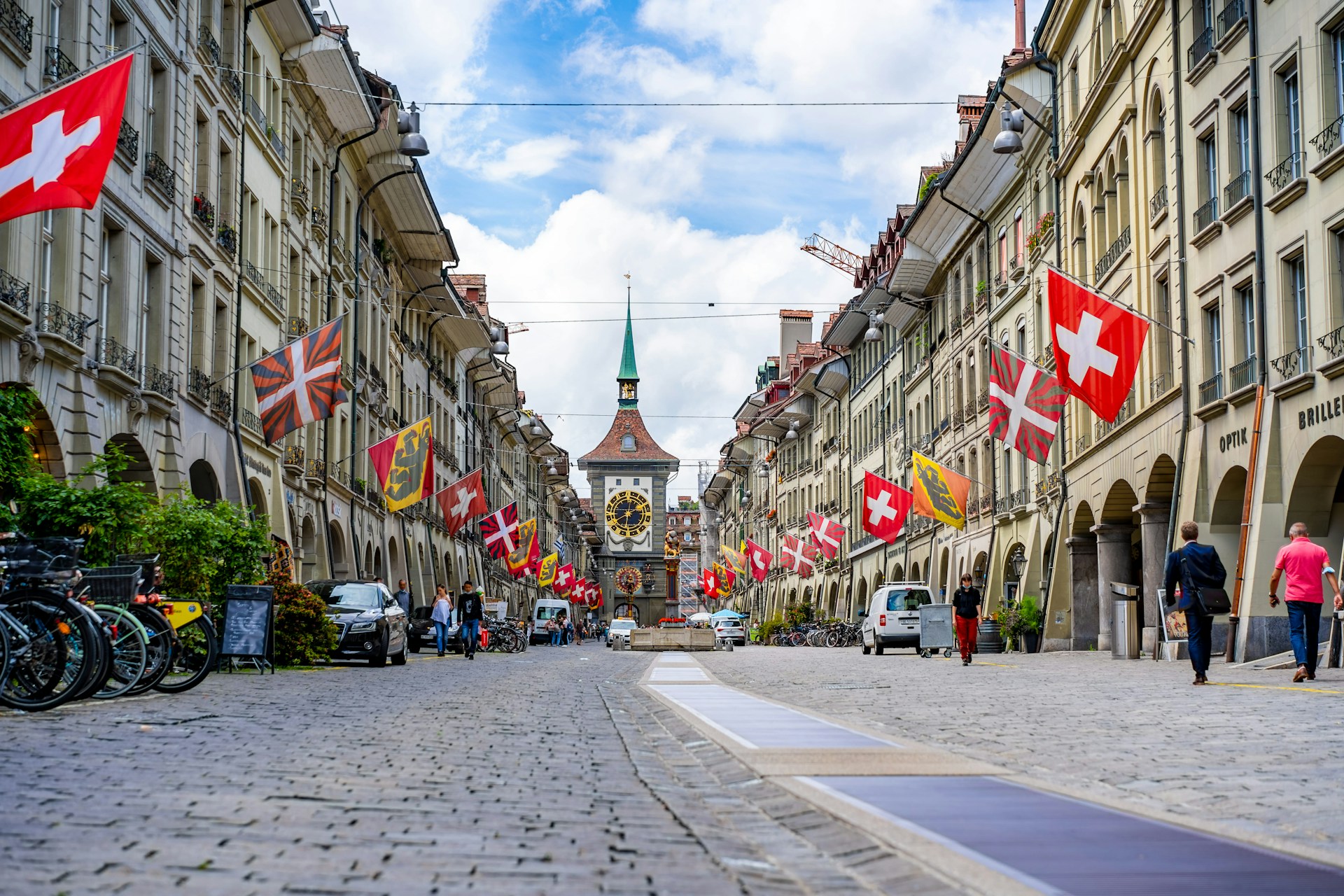
A medieval city on a sandstone peninsula, encircled by the Aare river — with 6 km of arcaded walkways, the Zytglogge clock tower, and a UNESCO-listed old town that has barely changed in 500 years.
Explore Bern on GetYourGuide →Bern is Switzerland's federal capital — and one of the least-expected capital cities in Europe. It sits on a narrow sandstone peninsula almost entirely encircled by a deep meander of the Aare river, giving the old town a natural moat on three sides. Founded in 1191 by the Duke of Zähringen, Bern grew into one of the most powerful city-states in medieval Europe, and its 15th- and 16th-century urban fabric has survived remarkably intact.
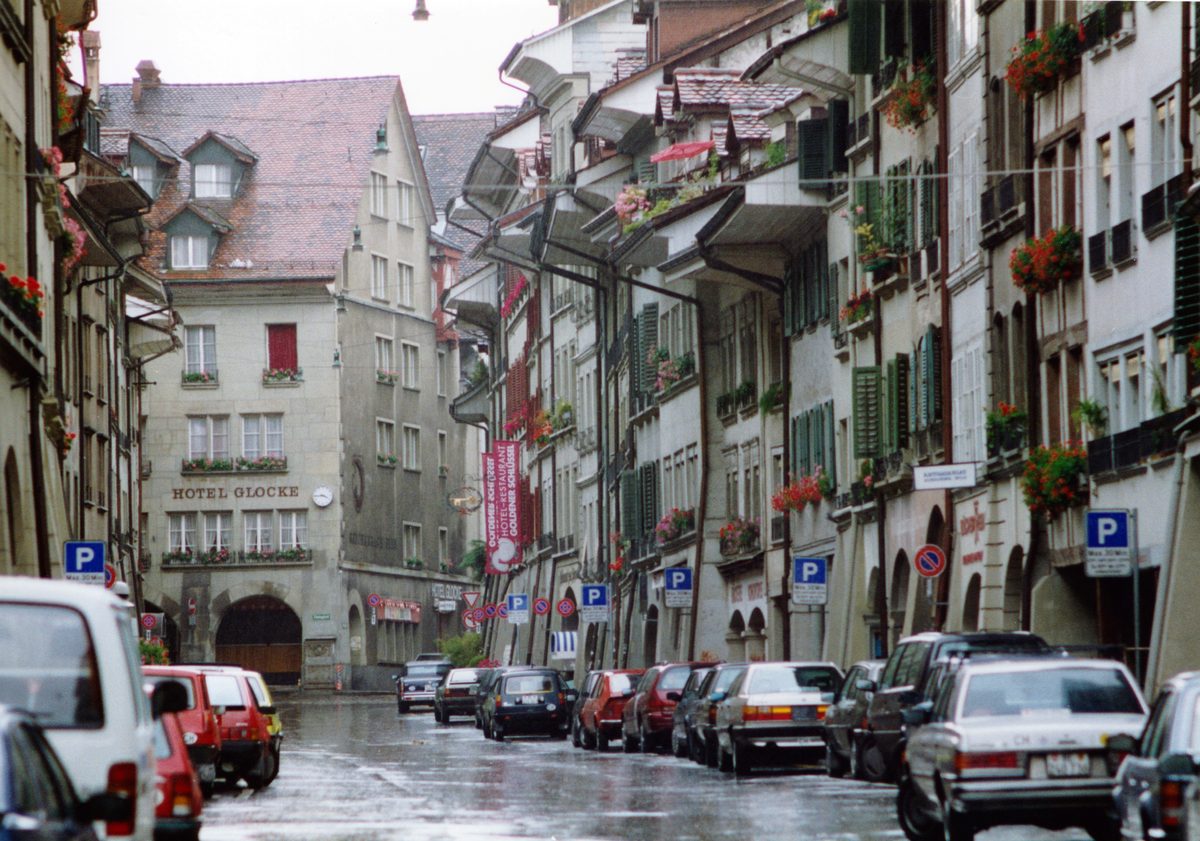
The UNESCO World Heritage designation (1983) covers the entire medieval old town — around 6 km of covered arcades (Lauben) that run continuously through the city centre, making Bern almost uniquely walkable in all weather. The sandstone buildings, guild house facades, and Renaissance fountains that line these colonnades have changed little since they were built.
Bern is often overlooked by visitors who pass through on the way to Interlaken or Zurich — a misjudgement. As Switzerland's political capital and a city of around 140,000 people, it has a lively local culture, excellent museums, and a slower pace than Zurich that makes it a very agreeable place to spend two or three days.
GetYourGuide offers old town walking tours, Zytglogge clock tower access, chocolate workshops, and day trips from Bern with instant confirmation.
View Bern Experiences →Bern's Altstadt is compact enough to walk across in 20 minutes, but dense enough to occupy most of a day. The main axis runs east–west along Kramgasse and Marktgasse — the original medieval market street — from the Zytglogge at its centre to the Käfigturm (Prison Tower) at the western end. Almost every step along this route passes under the covered arcades, past Renaissance fountains, and between guild-house facades decorated with ironwork signs.
The Zytglogge (Time Bell) is Bern's central landmark — a 13th-century clock tower at the eastern end of Marktgasse that has marked the hours since 1405. The astronomical clock mechanism on the east face activates four minutes before each hour: gilded figures rotate, a rooster crows, a jester rings bells, and bears (Bern's heraldic animal) parade in procession. The mechanism has run continuously for over 600 years. Guided tours of the interior and clock mechanism run daily — booking in advance is recommended in summer.
Bern's Lauben (arcades) are the feature that most distinguishes it from any other Swiss city. Six kilometres of covered colonnades run along the ground floors of the old town buildings on both sides of the main streets, sheltering pedestrians from rain and snow. The arcades contain an eclectic mix: bookshops, butchers, watchmakers, jewellers, pharmacies, and restaurants all occupy the spaces beneath the arches, many of which have been in continuous commercial use since the 15th century.
Below street level, many arcades connect to basement shops and wine cellars — Bern has an entire underground commercial layer beneath the colonnades that is easy to miss on a first visit. The covered market on Bärenplatz and the year-round stalls on Bundesplatz extend the street life further.
Eleven Renaissance fountains line the main streets of the old town, most dating from the 16th century and decorated with painted allegorical figures. The most famous is the Kindlifresserbrunnen (Child Eater Fountain, 1545) on Kornhausplatz — an ogre figure devouring children, whose original meaning has been debated by historians for centuries. The Zähringerbrunnen (Bear Fountain) on Kramgasse features a bear in armour — the heraldic symbol of Bern — and stands directly in front of the house where Albert Einstein lived from 1903 to 1905.
The Bundeshaus (Federal Palace) is Switzerland's parliament building, a domed Renaissance-style structure completed in 1902 at the western end of the old town on a terrace above the Aare. It houses both chambers of the Swiss Federal Assembly and is an active working parliament — the Federal Council (Switzerland's seven-member executive) meets here.
Free guided tours of the building are available on days when parliament is not in session — the interior, with its painted cantonal crests, marble floors, and the large central dome, is genuinely impressive. Booking is required through the parliament website. The Bundesplatz (Federal Square) in front of the building is used for markets and public events, and in summer a fountain of 26 jets (representing the 26 cantons) plays in the square.
From the Terrasse behind the Bundeshaus — a walkway along the edge of the sandstone cliff — the views down to the Aare far below, across to the Bernese Alps, and on clear days to the Eiger, Mönch, and Jungfrau are among the finest in any Swiss city. This terrace is free to access and one of Bern's essential viewpoints.
Bears have been kept in Bern since at least 1513, when the victorious Bernese army reportedly brought a live bear home from the Battle of Novara. The bear has been the city's heraldic symbol since its founding in 1191 (legend holds that Duke Berchtold V named the city after the first animal he killed in the hunt — a bear). The modern BearPark (Bern Bear Park) opened in 2009 at the eastern end of the old town, replacing the old round bear pit that had stood there since 1857.
The park is a 6,000 m² outdoor habitat built into the Aare riverbank, allowing Bern's brown bears to roam, dig, and swim in a naturalistic setting. Access is free; the bears are most active in morning and late afternoon. The park is a short walk from the old town across the Nydeggbrücke bridge and is easily combined with the Rosengarten above.
Above the BearPark, a 10-minute walk up the hill, the Rosengarten (Rose Garden) is a public park with over 220 rose varieties, 200 iris types, and 28 rhododendron varieties on a terrace overlooking the old town. It is free to enter and open year-round, though the roses peak in June. The view from the Rosengarten terrace — the sandstone old town on its peninsula, the Aare below, the Bundeshaus dome, and the Zytglogge tower — is the classic Bern panorama and is best photographed in afternoon light. The park café has outdoor seating with the same view.
Albert Einstein lived in Bern from 1902 to 1909, working as a patent examiner at the Swiss Federal Institute of Intellectual Property while developing his most important work. In 1905 — his annus mirabilis — he published four papers that transformed physics: the photoelectric effect (for which he later won the Nobel Prize), Brownian motion, special relativity, and mass-energy equivalence (E=mc²). All four were written while he was employed as a patent clerk in this city.
The apartment at Kramgasse 49 where Einstein lived from 1903 to 1905 is now the Einstein Haus (Einstein Museum) — a small, well-curated museum covering his life and work in Bern. The Bern Historical Museum (a short walk away) has a larger Einstein Museum in its lower floors, with extensive materials on his scientific legacy. For visitors with an interest in the history of science, Bern is a more significant location than is often recognised.
The Bernisches Historisches Museum is Switzerland's second-largest history museum, housed in a dramatic neo-Gothic castle (1894) near the Kirchenfeldbrücke. The permanent collection covers Swiss and Bernese history from prehistory to the modern era, with particularly strong holdings in medieval tapestries, religious sculpture, and Burgundian war booty captured from Charles the Bold at the Battles of Grandson, Murten, and Nancy (1476–77). The Einstein Museum occupies the lower ground floor. Admission is around CHF 13; closed Mondays.
Three kilometres east of the old town, the Zentrum Paul Klee is one of Europe's finest single-artist museums — designed by Renzo Piano (2005) as a wave-shaped building in the Schosshalde meadows. Paul Klee (1879–1940) was born near Bern and is the city's most celebrated artist; the centre holds around 4,000 of his works — the largest collection anywhere — and displays approximately 200 in rotating exhibitions at any time. The Renzo Piano building itself is architecturally significant. Free shuttle buses run from the Bern HB area; admission is around CHF 20.
The Naturhistorisches Museum Bern is one of the oldest natural history museums in Switzerland, with strong collections in mineralogy, zoology, and anthropology. Its most famous exhibit is Barry — the stuffed body of the legendary Saint Bernard rescue dog who allegedly saved over 40 lives in the Great St. Bernard Pass during the early 19th century. Admission is around CHF 9; closed Mondays.
Interlaken is 50 minutes by direct train from Bern, making it an easy day trip for Jungfraujoch (add ~2 hours), Lauterbrunnen, or Grindelwald. Bern is also a practical stopover between Zurich and Interlaken — the main line passes through Bern. See our Interlaken guide for what to do once you arrive.
Thun is 20 minutes south of Bern by train, at the northern end of Lake Thun. The medieval old town, the 12th-century Thun Castle (now a history museum with views of the lake and Alps), and the covered wooden bridge over the Aare make it a worthwhile half-day stop. The boat service from Thun along Lake Thun to Interlaken West takes about 2.5 hours and stops at Spiez and Oberhofen — a scenic approach to the Jungfrau region if you have an afternoon to spare.
Murten (Morat in French) is one of Switzerland's best-preserved medieval walled towns, sitting on the shore of the Murtensee lake 30 minutes by train from Bern. The intact medieval walls with their walkway, the old town gate towers, and the lakeside setting make it one of the most attractive small towns in the Swiss Plateau. It was the site of the 1476 Battle of Murten, where the Burgundians were decisively defeated — a turning point in Swiss history. Less visited than comparable towns in the Bernese Oberland.
Zurich is under an hour by direct InterCity train — making Bern and Zurich easy to combine in one trip without backtracking. See our Zurich guide for what to see and do.
The old town is almost entirely walkable — the main axis from Käfigturm to the Nydeggbrücke is about 1.2 km on foot through the arcades. Trams and buses cover the wider city, including the Rosengarten (bus), the Zentrum Paul Klee (shuttle), and the Bern Historical Museum (tram). Bern HB (Hauptbahnhof) is at the western edge of the old town — most sights are within 15 minutes on foot.
Bern is pleasant year-round, but the arcades make it particularly good in wet weather — you can spend a full day in the old town without an umbrella. Summer brings the weekly markets on Bundesplatz and outdoor dining in the squares. The Onion Market (Zibelemärit) in November — one of Switzerland's most colourful traditional markets, filling the old town with hundreds of stalls selling plaited onion ropes and crafts — is a strong reason to visit in late autumn. Christmas markets in December are among the most atmospheric in Switzerland.
Book guided tours and activities in Bern on GetYourGuide — instant confirmation, free cancellation on most bookings.
Browse the full selection of guided tours, activities, and day trips in Bern on GetYourGuide — free cancellation on most bookings.
View All Experiences in Bern →Bern's accommodation is concentrated near Bern HB and in the old town. It is significantly less expensive than Zurich or Geneva, and quality is generally high for the price paid.
Compare all available hotels in Bern on Klook — filter by price, location, and amenities.
View All Hotels in Bern on Klook →Guided walking tours cover the Zytglogge, arcades, Einstein's apartment, and the Bundeshaus — the most efficient way to cover the old town's history in two hours.
View Bern Walking Tours →Bern is worth at least a half day, and ideally a full day or overnight. The UNESCO old town is one of the best-preserved medieval city centres in Europe, the Bundeshaus terrace has one of the finest views of the Alps from any Swiss city, and the pace is more relaxed than Zurich or Geneva. If you are travelling from Zurich to Interlaken, Bern is directly on the main line — stopping for the afternoon and continuing the next morning costs nothing extra in rail time.
Switzerland's federal system was designed to avoid giving any single city or region dominance over the others. When the modern Swiss Confederation was established in 1848, Bern was chosen as the "federal city" (Switzerland technically has no formal capital — Bern is the seat of the Federal Assembly and Federal Council, but not constitutionally designated as a capital) as a compromise between the major linguistic and political regions. Zurich was too economically dominant; Geneva too close to France. Bern's central position and its status as the seat of the Bernese Confederation made it acceptable to all cantons.
The bear has been Bern's heraldic symbol since the city's founding in 1191. The name "Bern" is linked (in local legend, if not in etymology) to the German word for bear (Bär). Bears have been kept in the city as living symbols since at least 1513. The current BearPark opened in 2009 as a more humane alternative to the traditional round bear pit, giving the bears a large natural habitat on the Aare riverbank. The city's residents take the bears seriously — bear imagery appears throughout the old town on fountains, flags, and architecture.
The animated figures on the Zytglogge clock start moving exactly four minutes before each full hour, every hour throughout the day. To see the full sequence — the jester ringing bells, the rooster crowing, the bears and the knight in procession — position yourself in front of the east face of the tower about five minutes before the hour. The sequence lasts about two minutes and concludes with the large bell striking the hour. The mechanism has been running continuously since 1530.
Yes — on clear days, the entire Bernese Alps panorama is visible from Bern, including the Eiger (3,967 m), Mönch (4,107 m), and Jungfrau (4,158 m), as well as the Stockhorn, Niesen, and Blüemlisalp. The best viewpoints are the Bundeshaus Terrasse, the Rosengarten, and the Gurten (858 m) — the local mountain above Bern, reached by funicular from the Gurtenbahn station in about 20 minutes. The Gurten gives a 360° panorama of the city, the Swiss Plateau, and the full Bernese Alps chain on clear mornings.
One full day covers the old town highlights: Zytglogge, arcades, Bundeshaus and terrace, BearPark, and Rosengarten. Two days allows the Zentrum Paul Klee, the Bern Historical Museum, and a half-day trip to Thun or Murten. If using Bern as a base for Interlaken day trips, add a day per excursion — Bern's lower hotel prices make it a practical alternative to staying in Interlaken itself.