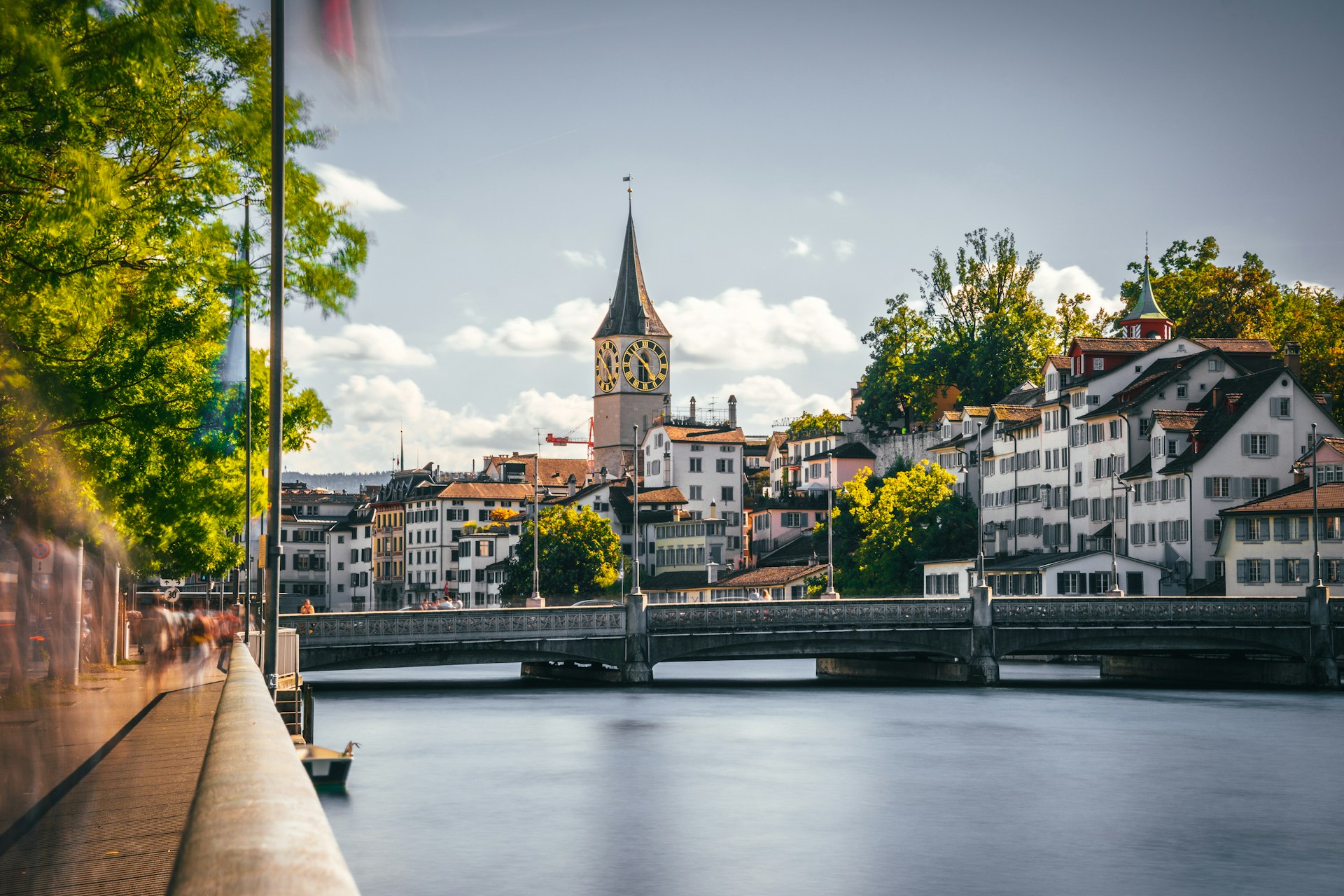
A medieval old town on a glacial lake, with world-class museums, the Bahnhofstrasse shopping boulevard, and the best train connections to anywhere in Switzerland.
Explore Zurich on GetYourGuide →Zurich is Switzerland's largest city, sitting at the northern tip of Lake Zurich where the Limmat river flows north out of the lake. With a population of around 440,000 in the city (over a million in the metropolitan area), it is the country's economic and cultural capital — home to its stock exchange, major banks, two universities, and a concentration of cultural institutions that punches well above its size.
For travellers, Zurich works both as a destination in its own right and as the main entry point into Switzerland. Zurich Airport (ZRH) is the country's busiest international airport, and Zurich Hauptbahnhof (HB) — the main railway station — is the hub from which direct trains reach every major Swiss destination within 2–4 hours. It is entirely common to arrive at Zurich Airport and be in Interlaken, Lucerne, or St. Moritz by lunchtime.
What surprises first-time visitors is how liveable and walkable the city is. The Altstadt (old town) on both banks of the Limmat is compact, largely car-free, and visually intact — guild houses, medieval churches, and narrow lanes that have been inhabited continuously for over 2,000 years. The lake is clean enough to swim in during summer and is fronted by parks and lakeside promenades.
GetYourGuide offers old town walking tours, lake cruises, chocolate and fondue experiences, and Alpine day trips from Zurich with instant confirmation.
View Zurich Experiences →Zurich's old town straddles both banks of the Limmat. The right bank (Niederdorf / Oberdorf) is the more lively side — narrow medieval lanes, small restaurants, wine bars, and boutiques, with the Grossmünster cathedral rising above. The left bank (Lindenhügel) is quieter and more upmarket, centred on the Fraumünster church, famous for its windows by Marc Chagall, and the Lindenhügel hill with panoramic views of the old town and lake.
The Grossmünster (Great Minster) is the dominant symbol of Zurich — the twin-towered Romanesque church is visible from across the city. Founded in the 12th century, it was the base from which Huldrych Zwingli launched the Swiss Reformation in 1519, making it one of the most historically significant Protestant churches in Europe. You can climb one of the towers for views over the old town and lake.
The Fraumünster (Women's Minster) across the river is smaller but more visually spectacular inside: five large stained-glass windows by Marc Chagall (1970) and a rose window by Augusto Giacometti (1945) fill the choir with coloured light. Entry is free; visiting in morning light gives the best result.
Lindenhügel is a small hill at the southern end of the left bank, reachable on foot from the Fraumünster. The terrace at the top — with the Lindenhof square, a Roman fort site — is one of the best free viewpoints in the city: the old town, the Limmat, the Grossmünster towers, and the lake are all visible in a single panorama.
Bahnhofstrasse runs 1.4 km south from the main station to the lake, and is consistently ranked among the most expensive shopping streets in the world. At the northern end, the shops are a mix of Swiss watchmakers (Rolex, IWC, Patek Philippe), major department stores (Jelmoli, Manor), and luxury fashion. Towards the lake end, the street opens onto Bürkliplatz and the lakeside promenade.
Below ground, Bahnhofstrasse is famous for a different reason: Paradeplatz, at its midpoint, is the headquarters of both UBS and Credit Suisse (now absorbed into UBS). The area directly around Paradeplatz is said to contain more gold in bank vaults beneath the street than almost anywhere else in the world — Swiss banking discretion means the figure is not published, but estimates are in the thousands of tonnes.
Most visitors walk the street once end to end and spend time browsing the watch and chocolate shops. The Sprüngli café at Paradeplatz — one of Switzerland's most famous confectioners, founded in 1836 — is worth a stop for coffee and their Luxemburgerli macarons.
Lake Zurich (Zürichsee) is 40 km long and up to 4 km wide, stretching south-east from the city into the hills of the Zürich Oberland. The lakeside in the city — the Zürichhorn on the right bank and Enge/Wollishofen on the left — has parks, outdoor swimming areas (called Badis), and cafés that fill up in summer.
Swimming in Lake Zurich is a genuine local tradition. From May through September, Zurichers swim in the lake from bathing establishments along both shores. The Zürichhorn Badi and the Seebad Enge are popular options, both directly on the water. The lake water is clean, glacier-fed, and carefully monitored — water quality is published daily.
Lake boat services run year-round, operated by ZSG (Zürichsee-Schifffahrtsgesellschaft). The full round trip to the far end of the lake and back takes about 2.5–3 hours and passes through the hills of the Zürich Oberland with views of the Alps on clear days. Shorter trips to Rapperswil (a medieval town at the lake's midpoint) take about 1.5 hours each way. Swiss Travel Passes are valid on ZSG services.
The Kunsthaus Zürich is the largest art museum in Switzerland and one of the most important in the German-speaking world. The original 1910 building was expanded significantly in 2021 with a new wing by architect David Chipperfield — the extension doubled the exhibition space and gave the museum a permanent home for its exceptional 20th-century collection.
The collection spans medieval to contemporary, with particular strengths in Swiss art (Giacometti, Hodler, Füssli), German Expressionism, French Impressionism (Monet, Degas, Picasso), and post-war American painting (Rothko, Pollock). The Bührle Collection — 200 Impressionist and Post-Impressionist works, one of the finest private collections ever assembled — is now permanently housed in the Chipperfield wing.
Admission is around CHF 23 for adults; the museum is closed on Mondays. The Swiss Museum Pass (valid for most Swiss residents) grants free entry. For visitors, the Kunsthaus is worth a half day and is easily combined with the nearby Zurich University area and the Polyterrasse viewpoint above.
A kilometre west of the main station, the former industrial district of Zurich West (Kreis 5) has transformed over the past 25 years into the city's most dynamic cultural quarter. The area around Langstrasse and the former rail yards is now home to art galleries, music venues, design studios, restaurants, and nightclubs.
The Puls 5 complex, a converted Sulzer machinery hall, is a good orientation point — it contains shops, restaurants, and a weekend market in the original industrial shell. The Schiffbau (shipbuilding hall) beside it now houses the Schauspielhaus theatre company's large-scale productions. The area around Hardbrücke railway bridge and the emerging Koch-Areal neighbourhood represent Zurich at its most contemporary.
Zurich West is primarily an evening destination — its bars and restaurants open late and the neighbourhood becomes progressively more lively after 9 pm. For visitors staying in the city for more than two nights, it offers a useful contrast to the more polished old town.
Directly adjacent to Zurich Hauptbahnhof, the Swiss National Museum (Schweizerisches Nationalmuseum) occupies a dramatic neo-Gothic castle built in 1898. It is the largest history museum in Switzerland, covering Swiss history from prehistory through to the 20th century across three floors and a new contemporary wing added in 2016.
Highlights include an exceptional collection of medieval stained glass from Swiss monasteries and churches, armour and weaponry from the Swiss Confederation's military history, a reconstructed Renaissance room from a Swiss manor house, and permanent exhibitions on Swiss identity, immigration, and modernity. The museum is free on the first Saturday of each month; standard admission is around CHF 10. Closed Mondays.
For visitors arriving at Zurich Airport who have a few hours before their connection, the National Museum is conveniently accessible on foot from the main station and can fill two hours usefully without requiring a separate trip.
Zurich's position at Switzerland's rail hub makes it an excellent base for day trips. The following are all reachable in under 2.5 hours from Zurich HB:
Switzerland's most iconic city photograph — the Chapel Bridge, the Water Tower, and the mountains reflected in Lake Lucerne — is 50 minutes by direct train from Zurich HB. Lucerne makes an easy half-day or full-day excursion; add Mount Pilatus (reached by the world's steepest cogwheel railway from Alpnachstad) or Mount Rigi (by boat from Lucerne and rack railway) to extend into a full mountain day.
The Rheinfall near Schaffhausen is the largest waterfall in Europe by volume — 373 metres wide, 23 metres high, and carrying up to 1,250 cubic metres per second in summer snowmelt. Boat services take you to a rock outcrop in the middle of the falls. Reach Neuhausen am Rheinfall station directly from Zurich HB in about 40 minutes. The falls are most dramatic in June and July when snowmelt is at its peak.
Interlaken is 2 hours from Zurich HB by direct train. From Interlaken Ost, Jungfraujoch (3,454 m, Europe's highest railway station) is a further 2 hours. A full day trip from Zurich to Jungfraujoch and back is possible but long — most visitors prefer to stay at least one night in Interlaken. See our Interlaken guide and Jungfraujoch guide for full details.
The Bernina Express departs from Chur, reachable in 1 hour 20 minutes from Zurich. From Chur, the Bernina Express runs to St. Moritz (1.5 hours, through the Albula valley) and then over the Bernina Pass to Tirano in Italy. A full Bernina Express experience typically requires an overnight stay in St. Moritz or Pontresina — Zurich to Tirano and back in one day is achievable but exhausting. See our Bernina Express guide for route details and seat tips.
Stein am Rhein is a small medieval town on the Rhine where it exits Lake Constance (Bodensee). The old town is exceptionally well preserved, with late-medieval frescoed guild houses around a central market square that appear almost unaltered since the 16th century. It is one of the most striking small towns in Switzerland and sees far fewer visitors than Lucerne or Interlaken. The boat service from Schaffhausen along the Rhine to Stein am Rhein takes about 1 hour 15 minutes and can be combined with the Rhine Falls for a full day on the water.
Zurich's public transport network (ZVV) is one of the most efficient in the world. Trams, buses, suburban trains (S-Bahn), and boats all run on the same ticket system with departures every few minutes on most routes. The old town and lake area are entirely walkable; trams are useful for reaching Zurich West and the university quarter.
Guests at most Zurich hotels receive a ZüriCityCard or the Zürich Guest Card (issued at check-in), which provides free or discounted public transport and museum entry. Ask at your accommodation whether this applies — it typically covers trams, buses, and S-Bahn within the city zone.
Zurich is a year-round destination. Summer (June–August) is the most popular: lake swimming, outdoor dining, and long evenings. The city fills up during major events, especially Street Parade in August — Europe's largest techno festival, attracting over a million visitors. Spring and autumn are quieter and often have the clearest days for Alpine views. Winter brings a celebrated Christmas market on Sechseläutenplatz (November–December) and the city's proximity to ski resorts within 1–2 hours.
Book guided tours and activities in Zurich on GetYourGuide — instant confirmation, free cancellation on most bookings.
Browse the full selection of guided tours, activities, and day trips in Zurich on GetYourGuide — free cancellation on most bookings.
View All Experiences in Zurich →Zurich has a full range of accommodation. First-time visitors should usually stay near Zurich HB, the old town, or the lakefront — all within easy reach of trams and the S-Bahn.
Compare all available hotels in Zurich on Klook — filter by price, location, and amenities.
View All Hotels in Zurich on Klook →Guided day trips from Zurich to Jungfraujoch, Lucerne, and the Bernina Express route — with all transfers and tickets included.
View Day Trips from Zurich →Two full days covers the main highlights: half a day for the old town (Grossmünster, Fraumünster, Lindenhof), half a day for Bahnhofstrasse and the lake, one day for the Kunsthaus and a day trip to Lucerne or the Rhine Falls. If you are using Zurich as a base for Alpine day trips (Interlaken, Jungfraujoch), add a day for each major destination. The city itself rarely needs more than three days.
Yes — Zurich consistently ranks among the most expensive cities in the world. Expect to pay CHF 5–7 for a coffee, CHF 20–35 for a main course at a mid-range restaurant, and CHF 150–300 per night for a hotel room. Supermarkets (Migros, Coop) are substantially cheaper than restaurants. Public transport is expensive by European standards but excellent — a 24-hour pass within the city zone costs around CHF 8.80.
Yes, on clear days. The best views are from elevated points: the Lindenhof terrace in the old town, the Polyterrasse behind ETH Zurich, and Uetliberg (871 m), the local mountain reached by direct S-Bahn from Zurich HB in about 20 minutes. From Uetliberg, the entire chain from the Säntis to the Bernese Alps is visible on clear winter mornings. Summer haze often reduces visibility; autumn and winter give the clearest Alpine panoramas.
For first-time visitors, the old town (Niederdorf) and the area immediately around Zurich HB give the best access on foot to the main sights and quick access to all train connections. For a more local feel, Zurich West (Kreis 5) has the city's best restaurant and bar scene. The lakeside area (near Bürkliplatz) is quiet and upmarket with direct park access. All three are within easy reach of each other by tram.
It depends on your itinerary. If you plan multiple train day trips — Lucerne, Interlaken, Rhine Falls, Bern — a 3- or 4-day Swiss Travel Pass usually pays for itself quickly. The pass includes all SBB intercity trains, most mountain railways, and many lake boat services, plus free entry to over 500 museums including the Kunsthaus and National Museum. If you are staying mostly in Zurich with only one major Alpine trip, calculate the individual fares first.
Swiss German (Züritüütsch) is the everyday spoken language of Zurich, but it is significantly different from standard High German — a distinct dialect that even German speakers from Germany find difficult to follow. However, standard High German is understood everywhere and widely used in written contexts and more formal settings. English is spoken fluently by nearly all hospitality and transport workers, and most signs and transport information are available in English. Visitors do not need to speak German.
For scenery: Lucerne with Mount Pilatus or Rigi is the classic choice — easy, affordable, and among the most beautiful landscapes in Switzerland. For something more unusual: the Rhine Falls combined with Stein am Rhein gives an excellent full day with minimal crowds. For a major Alpine experience: Jungfraujoch from Interlaken (allow a full day from Zurich, around 9 hours return). For the Bernina Express: base overnight in St. Moritz or Pontresina rather than attempting a Zurich–Tirano–Zurich in one day.