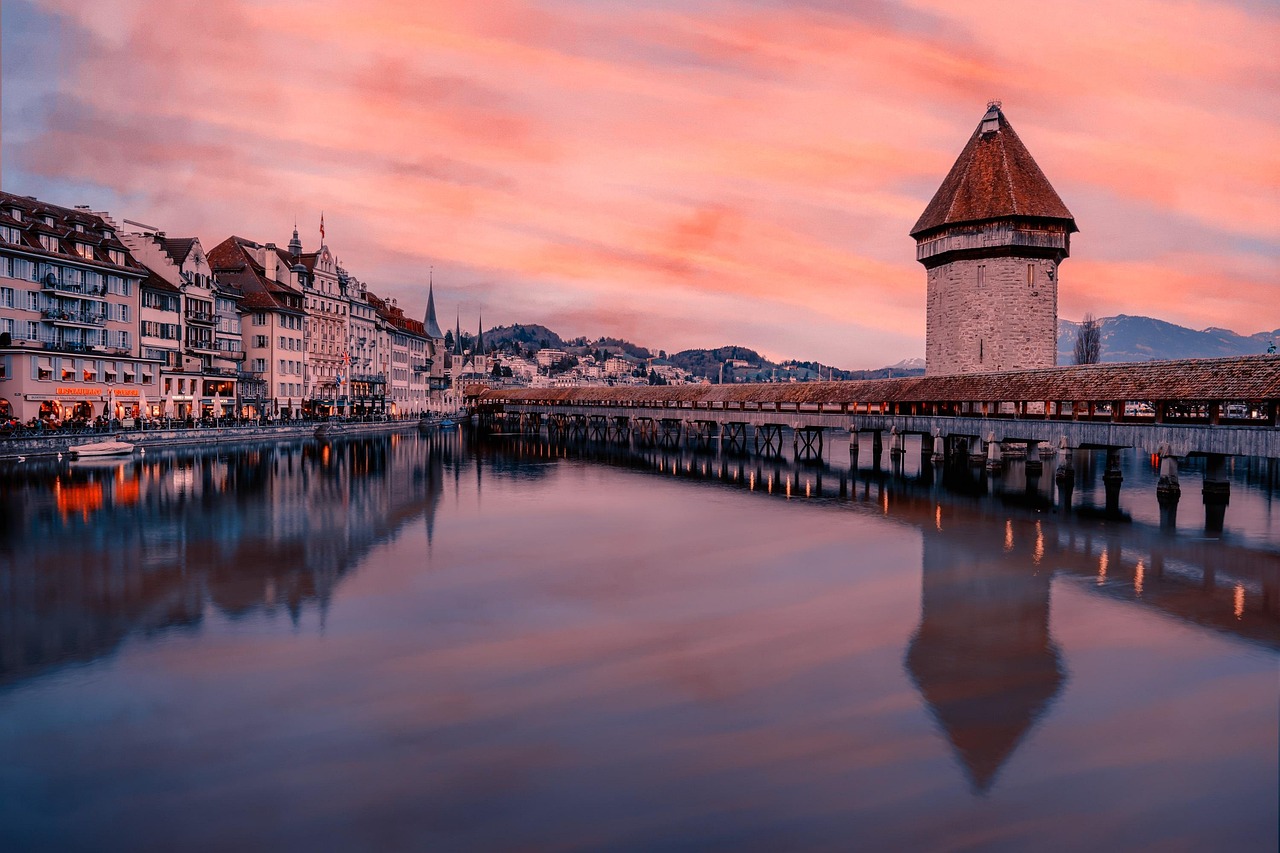
One of Switzerland's most photographed cities — a medieval old town on the Reuss river, the iconic Chapel Bridge, and a lake framed by mountains, with Mount Pilatus and Mount Rigi rising from the water's edge.
Explore Lucerne on GetYourGuide →Lucerne (Luzern) sits at the northern end of Lake Lucerne (Vierwaldstättersee — "Lake of the Four Forest Cantons") where the Reuss river exits north. With around 82,000 inhabitants, it is the largest city in Central Switzerland and one of the most visited in the country — not because of its size but because of its setting: a compact medieval old town on the river, a glacial lake ringed by mountains, and two of Switzerland's most famous mountain excursions (Pilatus and Rigi) accessible directly by boat and rack railway.
Lucerne is also historically significant as the heartland of the Swiss Confederation. The three original forest cantons — Uri, Schwyz, and Unterwalden — that formed the first alliance in 1291 (the founding act of Switzerland) lie around Lake Lucerne, and the city has been a commercial and cultural centre of this region since the 13th century. The old town's towers, walls, and guild houses reflect centuries of prosperity from Alpine trade routes.
For travellers, Lucerne is one of the most rewarding cities in Switzerland for a short visit: the main sights are concentrated, the lake and mountain scenery is immediately accessible, and the city works well as both a day trip from Zurich and as an overnight base for mountain excursions.
GetYourGuide offers Mount Pilatus day trips, Lake Lucerne cruises, old town walking tours, and combined mountain experiences with instant confirmation.
View Lucerne Experiences →The Kapellbrücke (Chapel Bridge) is the defining image of Lucerne — a 14th-century covered wooden footbridge crossing the Reuss diagonally, with a detached octagonal stone water tower standing in the river beside it. At 170 metres, it is the longest covered wooden bridge in Europe and one of the oldest. It was built in 1333 as part of the city's fortifications; the interior roof panels, painted with scenes from Lucerne's history and the legends of its patron saints, were added in the 17th century.
In August 1993, a fire — accidentally started by a smouldering cigarette on a passing boat — destroyed two-thirds of the bridge and most of the painted panels. The bridge was rebuilt by April 1994 in its original form, and around 30 surviving panels have been restored and rehung. The reconstruction is faithful enough that most visitors are unaware of the fire; a plaque at the entrance explains the history.
The Wasserturm (Water Tower) beside the bridge dates from around 1300 — older than the bridge itself. It has served at various times as a watchtower, treasury, archive, and prison. It is not open to the public but is the compositional anchor of the classic Lucerne photograph: the bridge, the tower, and the mountains reflected in the Reuss. The best light for photography is early morning before the tourist boats begin moving.
Lucerne's Altstadt occupies both banks of the Reuss. The north bank (right bank) contains most of the commercial activity — the covered arcades of the Kornmarkt and Weinmarkt (Wine Market Square), with their guild-house facades painted in elaborate frescoes, are the visual heart of the old town. The Spreuerbrücke (Spreuer Bridge, 1408) downstream from the Chapel Bridge is a second covered wooden bridge — less famous but arguably more atmospheric, with a complete set of 17th-century Dance of Death paintings lining the entire length of the interior.
The Museggmauer — a 870-metre stretch of medieval city wall with nine towers, dating from the 14th century — runs along the northern edge of the old town on the hillside above. Three of the towers are open to the public in summer and offer elevated views over the old town, river, and lake. The Zytturm (Time Tower) on the wall has the oldest clock in Lucerne, and by tradition its bell strikes one minute before all other clocks in the city — a privilege granted in 1535 that is still observed.
The Löwendenkmal (Lion Monument) is a 10-metre bas-relief carving of a dying lion cut directly into a sandstone cliff face in a small park near the old town. Carved in 1820 to a design by Bertel Thorvaldsen, it commemorates the Swiss Guards who died defending the Tuileries Palace in Paris during the French Revolution in August 1792 — when a revolutionary mob stormed the palace and 600 of the 900 Swiss Guards protecting Louis XVI were killed.
Mark Twain, who visited Lucerne in 1880, described it as "the most mournful and moving piece of stone in the world." The lion lies dying with a spear broken in its side, protecting a shield bearing the French royal fleur-de-lis with one paw and the Swiss cross with the other. The monument is free to visit, set in a quiet garden with a small reflecting pool, and takes about 15 minutes to see — but it is genuinely affecting and historically significant as a record of Swiss mercenary service.
Mount Pilatus (2,132 m) is the mountain directly above Lucerne to the south-west, rising from the lake's edge in a jagged limestone massif. It is the most popular mountain excursion from the city and one of the most accessible summit experiences in Switzerland — not requiring any hiking if you use the mechanical ascent options.
The classic excursion is the Golden Round Trip: boat from Lucerne across the lake to Alpnachstad (about 1.5 hours), then the Pilatus Cogwheel Railway — with a gradient of up to 48%, the steepest rack railway in the world — to the summit (about 30 minutes), followed by gondola and cable car descent to Kriens, and a short bus or tram back to Lucerne. The full circuit takes 5–6 hours and showcases the lake, the cogwheel ascent, and the summit panorama in a single loop.
From the summit, on clear days, the view spans over 70 Alpine peaks across four countries — including the Bernese Alps (Jungfrau, Mönch, Eiger), the Titlis, and the Gotthard massif. The summit has two hotels and a restaurant; staying overnight allows sunset and sunrise views above the clouds. The cogwheel railway operates from May to November only (weather dependent); the gondola and cable car run year-round.
Mount Rigi (1,798 m) rises from the lake on the opposite shore — a broad, rounded summit accessible from two directions: by boat and rack railway from Vitznau (on the lake, 40 minutes by boat from Lucerne), or by cable car from Weggis. The Vitznau–Rigi Rack Railway, opened in 1871, was the first rack railway in Europe and the second in the world — a significant piece of Swiss transport history.
Rigi is often called the Queen of the Mountains — a title earned from its panoramic position above the surrounding lakes. The summit at Rigi Kulm commands a 360° view taking in Lake Lucerne, Lake Zug, and Lake Lauerz below, and a full Alpine panorama from the Bernese Alps to the Appenzell. Sunrise from Rigi Kulm — watched from the terrace hotel as the Alps emerge from morning cloud — has been a celebrated experience since the early 19th century; Turner painted it, and Twain wrote about it.
Rigi is well suited to walkers who want a gentler mountain day than Pilatus — the summit plateau has maintained hiking trails, and the lower slopes have a network of routes through meadows and forest. Swiss Travel Passes are valid on the Vitznau rack railway and lake boats.
Lake Lucerne (Vierwaldstättersee) is one of the most topographically dramatic lakes in Switzerland — not a single basin but a system of interconnected arms extending into the pre-Alpine mountains, with the Gotthard massif at the far southern end. Its irregular shape means that views shift completely as you travel by boat: calm open water near Lucerne gives way to steep forested slopes, then narrow fjord-like inlets near Flüelen at the southern tip.
Lake steamers operated by SGV (Schifffahrtsgesellschaft des Vierwaldstättersees) run scheduled services from Lucerne to all lake villages, including Vitznau (for Rigi), Alpnachstad (for Pilatus), Weggis, Brunnen, and Flüelen. The full trip to Flüelen and back takes about 5 hours each way — a full day on the water through some of the most historically significant terrain in Switzerland. Swiss Travel Passes are valid on all SGV services.
The lake is also the setting for the Tell's Chapel (Tellskapelle) near Sisikon — a small 16th-century chapel on a lakeside rock commemorating the legendary spot where William Tell leapt from the boat of his captors. Whether Tell was historical or mythological, the chapel and its setting are striking: the narrow lake arm at this point, with cliffs rising directly from the water, gives the landscape a genuinely dramatic quality.
The Verkehrshaus der Schweiz (Swiss Museum of Transport) is the most visited museum in Switzerland — a sprawling complex on the lakeside east of the old town covering the full history of Swiss mobility: trains, cars, aircraft, ships, cable cars, and space. The collection includes full-size steam locomotives, early Swiss aircraft, a planetarium, and an IMAX cinema. It is particularly good for families with children. Admission is around CHF 32; reachable by bus or boat from the city centre.
The Sammlung Rosengart in the old town holds one of the finest private art collections in Switzerland — assembled by the Lucerne art dealer Siegfried Rosengart and his daughter Angela over several decades. The core of the collection is Picasso: 125 works spanning his entire career, including paintings, drawings, and ceramics. The lower floors contain additional works by Klee, Miró, Chagall, Matisse, and Cézanne. A remarkable collection for a city of Lucerne's size. Admission around CHF 18; closed Mondays in winter.
Lucerne and Zurich are connected by direct InterCity trains every 30 minutes. The two cities are easy to combine — Lucerne as a half-day stop en route to or from Zurich, or as a base for a Zurich day trip. The train journey itself passes through the Reuss valley and is pleasant.
The Brünig Line — the rack railway connecting Lucerne to Interlaken via the Brünig Pass (1,002 m) — is one of Switzerland's most scenic regional routes. The journey passes through Brienz at the eastern end of Lake Brienz, with views of the turquoise lake and the Brienzer Rothorn. Total journey time is about 2 hours to Interlaken. Slower than the main line via Bern, but considerably more scenic.
Engelberg is a mountain village 1 hour south of Lucerne by train, at the base of the Titlis (3,238 m). The Titlis rotair gondola — a revolving cable car — ascends to the glacier at 3,020 m, where an ice cave and the Cliff Walk suspension bridge (Europe's highest suspension bridge at time of opening) are the main attractions. A popular day trip from both Lucerne and Zurich; particularly busy with visitors from South and East Asia.
The old town is entirely walkable — the Chapel Bridge, Lion Monument, Museggmauer, and Weinmarkt are all within 15 minutes on foot of Lucerne Hauptbahnhof. The Swiss Museum of Transport is about 20 minutes on foot or a short bus ride east. For Mount Pilatus (Golden Round Trip) and Mount Rigi, the lake boat services depart from the quay in front of the station.
Lucerne is visited year-round. Summer (June–September) is peak season — the lake, mountain excursions, and boat services are all at full operation, but the old town is very busy with tour groups in July and August. Spring (April–May) and autumn (October) are quieter with good weather and full mountain access. Winter brings the Lucerne Carnival (Fasnacht) in February or March — one of the most exuberant festivals in Switzerland, with five days of costumed processions and brass bands filling the old town day and night. The Pilatus cogwheel railway closes November to April; Rigi and the lake boats run year-round.
Book guided tours and activities in Lucerne on GetYourGuide — instant confirmation, free cancellation on most bookings.
Browse the full selection of guided tours, activities, and day trips in Lucerne on GetYourGuide — free cancellation on most bookings.
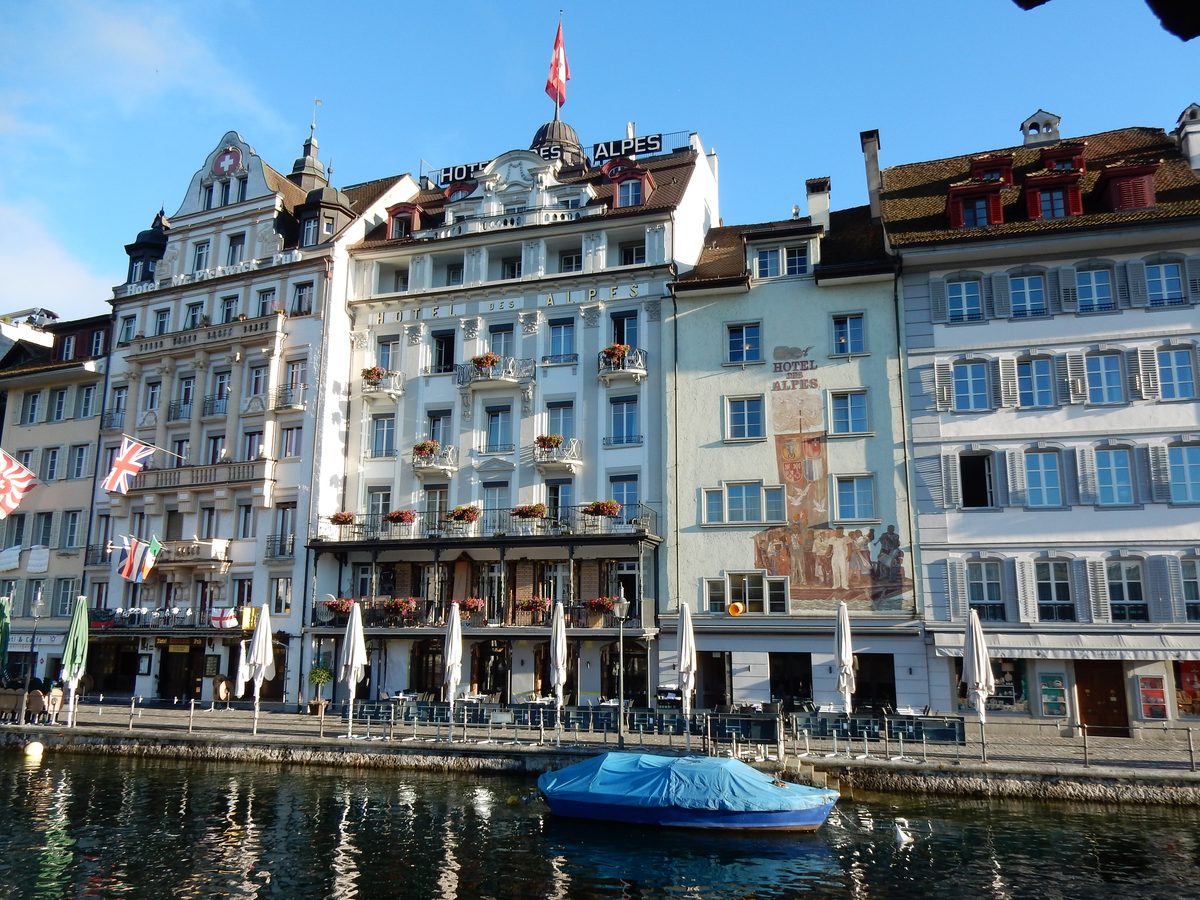
View All Experiences in Lucerne →Lucerne's accommodation is concentrated near the main station and along the lakefront. The old town has several characterful hotels within the medieval fabric; the lakeside has the grand historic hotels facing the water and mountains.
Compare all available hotels in Lucerne on Klook — filter by price, location, and amenities.
View All Hotels in Lucerne on Klook →The Golden Round Trip combines a lake boat crossing, the world's steepest cogwheel railway to the summit, and a gondola descent — the classic Lucerne mountain day.
View Mount Pilatus Day Trips →One full day covers the old town highlights: Chapel Bridge, Lion Monument, Museggmauer, and the lakefront. Two days allows either a Mount Pilatus or Mount Rigi excursion plus the Rosengart Collection or Swiss Museum of Transport. Three days lets you do both mountains. Lucerne also works as a day trip from Zurich — the 50-minute train makes it entirely feasible to see the old town and lake in half a day.
They offer different experiences. Pilatus (2,132 m) is more dramatic — a jagged rocky summit with a steeper ascent via the world's steepest cogwheel railway. The views are more expansive and the excursion more varied with the Golden Round Trip combining boat, cogwheel, and gondola. Rigi (1,798 m) is gentler — broader summit plateau, better for walking, and famous for sunrise views. Pilatus is typically the first choice for a single mountain day; Rigi suits those who want a more peaceful, hiking-oriented experience. Both are excellent and distinctly different.
Mostly yes, with a significant caveat. The bridge was built in 1333 and stood largely intact for 660 years. A fire in August 1993 destroyed about two-thirds of the structure and most of its 17th-century painted ceiling panels. It was rebuilt in 1994 in faithful replica of the original. Around 30 of the original painted panels survived the fire and have been restored and rehung; the rest are reproductions. The stone Water Tower beside the bridge is entirely original from around 1300. A plaque at the bridge entrance explains the fire and reconstruction.
Partially. The Swiss Travel Pass covers the lake boat services, the Vitznau–Rigi rack railway (for Rigi), and the regular train network. For Mount Pilatus, the pass gives a 50% discount on the cogwheel railway (Alpnachstad–Pilatus) and the gondola/cable car descent — not free travel. The full Pilatus Golden Round Trip costs approximately CHF 72 at full price, or around CHF 36–40 with the Swiss Travel Pass discount. Always check the current pass benefits on the SBB website before visiting, as conditions can change.
Yes — easily. The 50-minute direct train from Zurich HB runs every 30 minutes. A day trip allows the old town, Chapel Bridge, Lion Monument, and the lakefront comfortably, with time for lunch. Adding a mountain excursion (Pilatus or Rigi) in the same day is possible but long — it makes for a full 10–11 hour day. For the best experience, consider staying one night in Lucerne to allow a relaxed morning in the old town before tourist groups arrive, and do the mountain on day two.
The Lucerne Fasnacht is one of the largest and most theatrical carnival celebrations in Switzerland — five days (Thursday to Tuesday) of costumed processions, brass bands (Guggenmusiken), masked figures, and street performances filling the old town from early morning to late at night. It begins at 5:00 am on the Thursday before Ash Wednesday with the Urknall (Big Bang) — a sudden eruption of music, light, and noise in the old town. The dates vary year to year (February or early March). The town becomes extraordinarily crowded; book accommodation many months in advance if you plan to visit during Fasnacht.