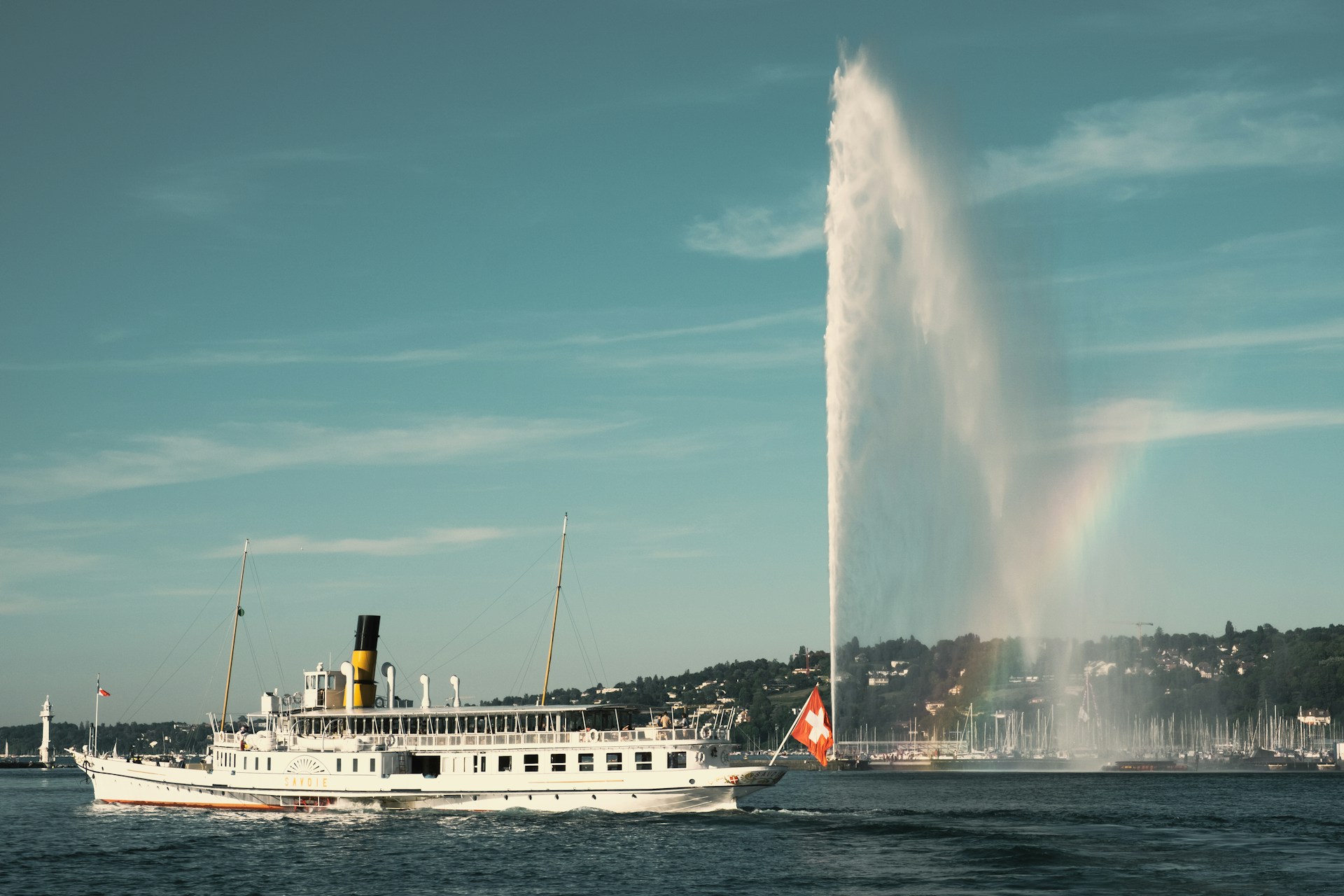
Europe's most international city, at the foot of the Alps on the shore of Europe's largest Alpine lake — with the Jet d'Eau, a historic old town, and the headquarters of the United Nations and Red Cross.
Explore Geneva on GetYourGuide →Geneva (Genève) sits at the western tip of Lake Geneva (Lac Léman) — Europe's largest Alpine lake — where the Rhône river exits north towards France. With around 200,000 inhabitants in the city and over 600,000 in the greater metropolitan area, Geneva is Switzerland's second-largest city and its most international: roughly 40% of its population holds a foreign nationality, and it hosts more international organisations than any other city in the world.
The United Nations European Headquarters, the International Red Cross and Red Crescent Movement, the World Health Organization, the World Trade Organization, and over 750 other international bodies are based here. This concentration of diplomacy, finance, and international institutions gives Geneva a cosmopolitan character unlike any other Swiss city — and a price level to match.
For visitors, Geneva offers a compact old town on a hill above the lake, the iconic Jet d'Eau fountain, world-class watchmaking museums, excellent connections to the French Alps (Chamonix, Mont Blanc), and — often overlooked — one of the most pleasant lakeside promenades in Europe. It is also one of the best entry points into Switzerland, with Geneva Airport (GVA) connecting directly to cities across Europe and beyond.
GetYourGuide offers old town tours, lake cruises, chocolate and watchmaking experiences, and day trips to Chamonix and Mont Blanc from Geneva.
View Geneva Experiences →The Jet d'Eau is Geneva's defining image — a single column of water shooting 140 metres into the air from a pier in Lake Geneva, visible from across the city and from the air on approach to the airport. It is one of the tallest water fountains in the world and one of the most recognisable landmarks in Switzerland.
Its origin is prosaic: the Jet d'Eau was created in 1891 as a pressure release valve for the city's hydraulic power network, originally installed on the Rhône. When the network was expanded and the discharge point moved to the lake, the fountain became a landmark by accident. The current installation shoots 500 litres of water per second at 200 km/h; the column weighs approximately 8 tonnes when fully active.
The Jet d'Eau is visible from the Quai du Mont-Blanc and from the Pont du Mont-Blanc bridge — the latter giving the classic view with the Alps behind. It runs daily from March to October (weather and wind permitting; it is shut down in strong winds to avoid drenching the quayside). Walking out to the pier at the base of the fountain, where the spray catches the light and creates rainbows on sunny days, is worth the short detour from the lakeside promenade.
Geneva's Vieille Ville (Old Town) occupies a steep hill on the left bank of the Rhône, above the lake. It is smaller and less immediately picturesque than Bern's Altstadt, but historically significant — Geneva was the centre of the Protestant Reformation under John Calvin from 1541, and the city's character was shaped by Calvinist austerity in ways still visible today.
St. Peter's Cathedral (Cathédrale Saint-Pierre) dominates the old town from the top of the hill. The building dates from the 12th century, with a neoclassical facade added in the 18th century that sits incongruously above the Romanesque nave. The interior was stripped of Catholic decoration by the Reformers in 1535 — Calvin preached here from 1536 until his death in 1564, and his simple wooden chair remains in the north aisle. Climbing the north tower (157 steps) gives the best panoramic view of the old town, the lake, and — on clear days — Mont Blanc (4,808 m).
Place du Bourg-de-Four is the oldest square in Geneva — a Roman forum that has functioned as a marketplace continuously for 2,000 years. Today it is the social heart of the old town, ringed by cafés and restaurants with outdoor terraces. The square is accessible on foot from the cathedral in five minutes, and most walking tours of the Vieille Ville pass through it.
The Mur des Réformateurs (Reformation Wall, 1917) in the Parc des Bastions is a 100-metre-long bas-relief monument to the leaders of the Protestant Reformation: Calvin, Farel, Bèze, and Knox stand at the centre, flanked by scenes from Reformation history across Europe. Geneva's motto — Post Tenebras Lux (After Darkness, Light) — is carved above. The park is free to enter and a few minutes' walk from the old town; it also contains a large outdoor chess set popular with locals year-round.
The Palais des Nations — the European headquarters of the United Nations, built between 1929 and 1938 for the League of Nations — occupies a large park north of the city centre. Guided tours of the interior are available when the UN is not in session; the tour covers the Assembly Hall, Council Chambers, and the history of international diplomacy from the League of Nations through to the present day. The park contains notable outdoor artworks including the Broken Chair sculpture on the Place des Nations — a giant wooden chair with a shattered leg, a monument to victims of landmines and cluster munitions.
The International Red Cross and Red Crescent Museum (Musée International de la Croix-Rouge) is directly adjacent to the Palais des Nations and is one of the most compelling museums in Geneva — covering the founding of the Red Cross by Henry Dunant (a Genevan) after the Battle of Solferino in 1859, through to humanitarian operations today. The permanent exhibition is well designed and covers difficult material with clarity. Admission is around CHF 15; closed Mondays.
Geneva is the global capital of haute horlogerie — high watchmaking. The city and its surrounding canton are home to Rolex, Patek Philippe, Vacheron Constantin, Chopard, and dozens of smaller independent ateliers producing the world's most expensive mechanical watches. The concentration of watchmaking expertise in the Geneva region has been continuous since the 16th century, when Calvinist restrictions on jewellery led goldsmiths to redirect their skills into watchmaking.
The Patek Philippe Museum in Plainpalais is the finest watch museum in Switzerland — five floors of historical and contemporary timepieces, enamel miniatures, and mechanical automata. The collection includes watches dating from the 16th century, and the upper floors showcase Patek Philippe's own production from 1839 to the present. Admission is around CHF 10; closed Sunday and Monday.
The Rue du Rhône and the adjacent streets on the right bank are the main luxury shopping axis — Patek Philippe, Rolex, Cartier, and every major luxury brand have flagship boutiques here. Window shopping is free; buying is not.
Lake Geneva (Lac Léman) is the largest Alpine lake in Europe — 73 km long, up to 14 km wide, and up to 310 m deep. The Swiss side of the lake (the eastern and northern shores) is flanked by the Swiss Riviera — a strip of towns and villages from Geneva east to Montreux, sheltered by the Alps to the north and warmed by the lake's thermal mass, giving a microclimate mild enough for palm trees and vineyards at the same latitude as northern Germany.
The lakeside promenade in Geneva — the Quai du Mont-Blanc and Quai Wilson on the right bank, and the Quai Gustave-Ador on the left — is one of the most pleasant urban waterfront walks in Europe. Flowers, benches, and a string of lakeside parks extend several kilometres; in summer, outdoor swimming areas (bains) open directly on the lake.
Lake boat services (CGN — Compagnie Générale de Navigation) run from Geneva to Lausanne, Montreux, Évian-les-Bains (France), and other stops. The full round-trip to Montreux takes about 3.5 hours each way by regular service, or about 2 hours by express catamaran. Swiss Travel Passes are valid on CGN services. A day cruise on the lake, with the Alps visible on the south shore (the French side, including Mont Blanc on clear days), is one of Geneva's best experiences.
Chamonix-Mont-Blanc in France is the most dramatic day trip from Geneva — a valley town directly beneath the highest peak in the Alps (4,808 m), with the Aiguille du Midi cable car ascending to 3,842 m for a close-range view of the Mont Blanc massif. The train from Geneva Cornavin to Chamonix takes about 1.5 hours (change at St-Gervais). The Mer de Glace glacier is accessible from Chamonix by rack railway. No visa is required for EU or Swiss travel document holders; the border crossing is seamless.
Montreux is 1 hour from Geneva by express train along the north shore of the lake. The medieval Château de Chillon — built on a rock in the lake 3 km east of Montreux — is one of Switzerland's most visited historic sites, with intact medieval dungeons, great halls, and a lakeside setting that inspired Byron's poem The Prisoner of Chillon. Reachable by bus or on foot from Montreux. See our Montreux guide for full details.
Lausanne is the capital of the canton of Vaud and Switzerland's fourth-largest city, 40 minutes by train from Geneva. It sits on a steep hillside above the lake with an impressive Gothic cathedral, the headquarters of the International Olympic Committee (with the Olympic Museum on the lakeside), and a lively student city atmosphere. The lakeside district of Ouchy, with its port and promenade, is the most pleasant area to visit; the old town above is worth the climb for the cathedral and the medieval quarter.
Annecy — a French town 40 km south of Geneva at the north end of the turquoise Lac d'Annecy — is reachable by train in about 45 minutes. Its medieval old town with covered canals, the Château d'Annecy on the hill above, and the clear Alpine lake make it one of the most attractive towns in the French Alps. Day-tripping from Geneva to Annecy is straightforward and requires no Swiss Travel Pass (French territory — buy a French SNCF ticket separately).
Geneva and Bern are connected by direct InterCity trains throughout the day. Combining a night in Geneva and a day in Bern (or vice versa) before continuing to Zurich or Interlaken is one of the most common itineraries for a first visit to Switzerland.
Geneva's public transport network (TPG — Transports Publics Genevois) covers trams, buses, and boats within the city. Most visitors receive a free transport card valid for the duration of their stay when they check in to any Geneva hotel — ask at the front desk if it is not offered automatically. This card covers all TPG trams, buses, and the yellow lake boats (Mouettes Genevoises) within the city zone, at no cost to the visitor. It does not cover trains to Chamonix or CGN lake cruises.
The old town, the lakeside, and the international quarter around the Palais des Nations are all accessible on foot from the city centre, though the UN area is a 20-minute walk or a short tram ride (line 15) from Cornavin station.
Geneva is French-speaking — the everyday language is French, menus are in French, and street signs are in French only. However, English is widely spoken in hotels, restaurants, and tourist contexts, and the international population means German and Italian are also common. Visitors do not need French to navigate the city, but even a few words (bonjour, merci, s'il vous plaît) are well received.
Geneva is pleasant year-round. Summer (June–August) is warmest for lake swimming and outdoor dining; the lakeside fills with locals and the Jet d'Eau runs daily. Spring brings the famous Geneva flower displays along the Quai du Mont-Blanc — hundreds of thousands of tulips and narcissi planted along the waterfront. Autumn is clear with good Alpine views and the grape harvest on the Lavaux terraces east of the city. Winter brings the Geneva Lux festival (light installations across the city in December) and Christmas markets.
Book guided tours and activities in Geneva on GetYourGuide — instant confirmation, free cancellation on most bookings.
Browse the full selection of guided tours, activities, and day trips in Geneva on GetYourGuide — free cancellation on most bookings.
View All Experiences in Geneva →Geneva is one of the most expensive cities in the world for accommodation. The most practical areas are the right bank (near Cornavin station and the Quai du Mont-Blanc) and the left bank (near the old town and Plainpalais). Book well in advance — the city hosts numerous international conferences and trade fairs year-round that can fill hotels at short notice.
Compare all available hotels in Geneva on Klook — filter by price, location, and amenities.
View All Hotels in Geneva on Klook →Guided day trips to Chamonix, the Aiguille du Midi, and the Mont Blanc massif depart from Geneva with all transfers included.
View Mont Blanc Day Trips →Two full days covers the city well: one day for the old town (St. Peter's Cathedral, Reformation Wall, Place du Bourg-de-Four), the Jet d'Eau, and the lakeside promenade; one day for the Palais des Nations, the Red Cross Museum, and the Patek Philippe Museum. Add a third day for a day trip to Chamonix, Annecy, or Montreux. Geneva is compact — the main sights are concentrated and walkable.
Geneva and Zurich consistently compete for the title. Geneva tends to be slightly more expensive for hotels and dining, partly due to the concentration of international organisations and diplomatic staff with high expense accounts. Budget travellers find Geneva genuinely challenging — a cup of coffee can cost CHF 6–8, and a modest restaurant dinner CHF 35–50 per person. The free hotel transport card (TPG) is a useful saving, and supermarkets (Migros, Coop) provide significantly cheaper food than restaurants.
Yes — on clear days, Mont Blanc (4,808 m, the highest peak in the Alps) is visible to the south-east from Geneva, appearing above the French Prealps. The best city viewpoints are the tower of St. Peter's Cathedral and the north-facing windows of the old town. The view is clearest in winter and spring after precipitation, when the air is freshest. From Chamonix (1.5 hours by train), the view of Mont Blanc is dramatically closer and fills the entire southern horizon.
The Geneva hotel guest card covers TPG trams, buses, and the short-hop Mouettes Genevoises ferry boats crossing the Rhône within the city. It does not cover CGN lake cruises to Lausanne, Montreux, or Évian. The Swiss Travel Pass covers CGN services if you have one. Otherwise CGN tickets are purchased separately at the pier. Day cruises on the lake cost approximately CHF 30–60 per person depending on the route.
The Jet d'Eau runs daily from early March to mid-October, approximately 10:00 to sunset (later in midsummer). It is switched off in strong wind conditions to prevent the spray from drenching the lakeside promenade and nearby boats. In winter it operates on special occasions only — New Year's Eve and selected events. The fountain is remotely monitored and controlled; if it is not running on arrival, wind is usually the cause.
It depends on your itinerary. Geneva is well positioned for the Swiss Riviera (Montreux, Lausanne), the French Alps (Chamonix), and western Switzerland generally. It is further from Interlaken (~2.5 h) and Zermatt (~3.5 h via Brig) than Zurich or Bern. If your main interest is the Bernese Alps, Jungfraujoch, or Graubünden (Bernina Express), Zurich or Bern makes a more efficient base. For the Lake Geneva arc, the Valais, and France, Geneva is ideal.